Built on a legacy of service, the Coast Guard Reserve is delivering readiness today while transforming for the challenges of tomorrow.
By Rear Adm. Tiffany Danko, Director, Coast Guard of Reserve and Master Chief Petty Officer Will Adams, 9th Master Chief Petty Officer, Coast Guard Reserve
As the United States prepares to commemorate its 250th anniversary, the Coast Guard Reserve stands at a pivotal intersection of its own history and the nation’s future. For 85 years, this force of Citizen Warriors has answered the call, providing trained and ready personnel for critical missions in times of national need. This founding purpose is more relevant today than ever. The maritime domain is more contested, the demand for Coast Guard forces is at an all-time high, and the need for a modern, mobilized, and ready Reserve has never been clearer.
Then: A legacy of service to the nation
The story of the Coast Guard Reserve is a story of service. It is rooted in the uniquely American Citizen Warrior tradition, created by an act of Congress in 1941 to provide a surge force in times of crisis. For generations, reservists have balanced civilian careers and family responsibilities with the profound commitment to remain always ready—Semper Paratus—to mobilize when the nation calls. This legacy of devotion to constitutional duty is not just our history; it is the bedrock of our value to the Coast Guard and the Nation today.
From the shores of Normandy to the response following the September 11th attacks, the Reserve has consistently proven its worth as an indispensable component of the Total Force. This is not a force that waits; it is a force that trains, integrates, and prepares alongside its active-duty counterparts, ensuring seamless interoperability when the call comes. Our history demonstrates that the Reserve’s value is twofold: providing critical capacity during large-scale national emergencies, and offering specialized, mission-ready skills that augment daily Coast Guard operations. As an integral part of the Total Force, the Reserve extends the Coast Guard’s unique value as a military service, a law enforcement agency, a first responder, and a guardian of the nation’s economic prosperity.
Now: Readiness and operational impact
Today’s operating environment is defined by strategic competition, pressure on our maritime borders, and the persistent threat of crisis with little warning. In January 2026, Commandant Adm. Kevin Lunday articulated the Service’s path forward in three powerful words: Ready, Fight, Navigate. He made clear that readiness begins with the entire force: Active, Reserve, Civilian, and Auxiliary.
For the Reserve, this is our call to action. We are translating the Commandant’s intent into decisive outcomes through the Coast Guard’s generational transformation: Force Design 2028 (FD28). Under FD28, the Reserve is being deliberately repositioned to sharpen readiness, strengthen mobilization capacity, and align our force with the Service’s most critical missions: border control, flow of commerce, and contingency response.
This is not just a future goal; it is happening now. In 2025, we reaffirmed contingency mobilization as the Reserve’s primary mandate, codifying four mission types: Defense Operations, Maritime Security, Marine Environmental Response, and Emergency Management to improve clarity and strengthen training priorities. Our relevance is not theoretical; it is proven daily. Over the past year, more than 400 reservists mobilized to support border security operations like Vigilant Sentry, River Wall, and Border Trident, directly contributing to the security of our southern maritime approaches. In the Indo-Pacific, our Port Security Units (PSUs) deployed with the U.S. Navy, providing security for critical sea lanes essential to the global flow of commerce. These expeditionary units are a premier example of Reserve integration, bringing a vital capability to the Joint Force that does not exist in the active component.
Just as important as what we are doing is how we are preparing. A 2025 Readiness Sprint produced a 31% overall improvement in Reserve Component readiness, adding over 600 members to the pool of personnel fully prepared for short-notice contingency deployment. This success was not an accident; it was the result of a deliberate, data-driven effort to identify and remove the administrative barriers that hinder a reservist’s ability to serve. This achievement led directly to the establishment of the permanent Reserve Readiness Program, a formal system to ensure we can mobilize at speed and scale. This relentless focus on readiness is our core purpose. It’s about ensuring that when the worst day comes, the Coast Guard Reserve will be at its best.
Tomorrow: A transformed force for the future
If our past is defined by a legacy of service and our present by operational readiness, our future will be defined by how we modernize for the demands ahead. FD28 is the roadmap for that future, and its direction is crystal clear. The FD28 Executive Report explicitly directs the Coast Guard to, “…revitalize the Coast Guard Reserve and refocus it on preparation for full-scale mobilization in time of war, national emergency, or major contingency.”
This is a fundamental shift, moving beyond a model of individual augmentation to building a Reserve force that is predictable, integrated, and relentlessly focused on mission-aligned training. This transformation into a strategic mobilization asset is already underway, guided by three key lines of effort:
- A Mobilization-Focused Force: We are redesigning our force structure to ensure every billet and every training dollar is aligned with creating mobilization readiness. This means prioritizing the skills and units most needed in a major contingency, from port security to marine casualty response.
- A Mission-Ready Force: We are overhauling our training and readiness programs to ensure reservists are not just qualified, but proficient. This includes more integrated training exercises with active-duty and joint partners and leveraging technology to make training more accessible and effective.
- A Supported and Sustainable Force: We recognize that our people are our greatest strategic advantage. We are committed to improving talent management, from recruiting and retention to creating a system that honors a reservist’s commitment by making it easier to serve.
Talent management is central to this effort. While the Coast Guard exceeded its combined recruiting goal, bringing in over 5,000 new members in FY25, with Reserve enlisted recruiting reaching 104% of its mission, success is about more than numbers. It is about retaining skilled people and ensuring they can serve in a system that values their contribution. That is why initiatives like the Inactive Duty Training-Travel Reimbursement Program, which helps offset costs for the 25% of our reservists who live more than 150 miles from their unit, are essential readiness issues. They ensure we can recruit and retain the best talent, regardless of geography.
The future also demands that we evolve to meet emerging threats. To that end, the Reserve has established two new cyberunits: Coast Guard Reserve Unit U.S. Cyber Command and the 1941 Cyber Protection Team, bringing industry-leading expertise to protect $5.4 trillion in economic activity sustained by our Marine Transportation System. Our reservists in these units are cyber professionals in their civilian lives, offering a level of experience that would be difficult to replicate in the active force. This is the future of the maritime fight, and the Reserve is expanding into the mission spaces that will define it.
As America reflects on 250 years of service and sacrifice, the Coast Guard Reserve exemplifies an enduring commitment to the nation. We are a force built on a proud history, tested by today’s demands, and being transformed for the future. Honoring our legacy means preparing for what comes next: a future where readiness is paramount, mobilization is central, and our nation’s maritime security requires a Coast Guard Reserve that, as always, is ready for the call.
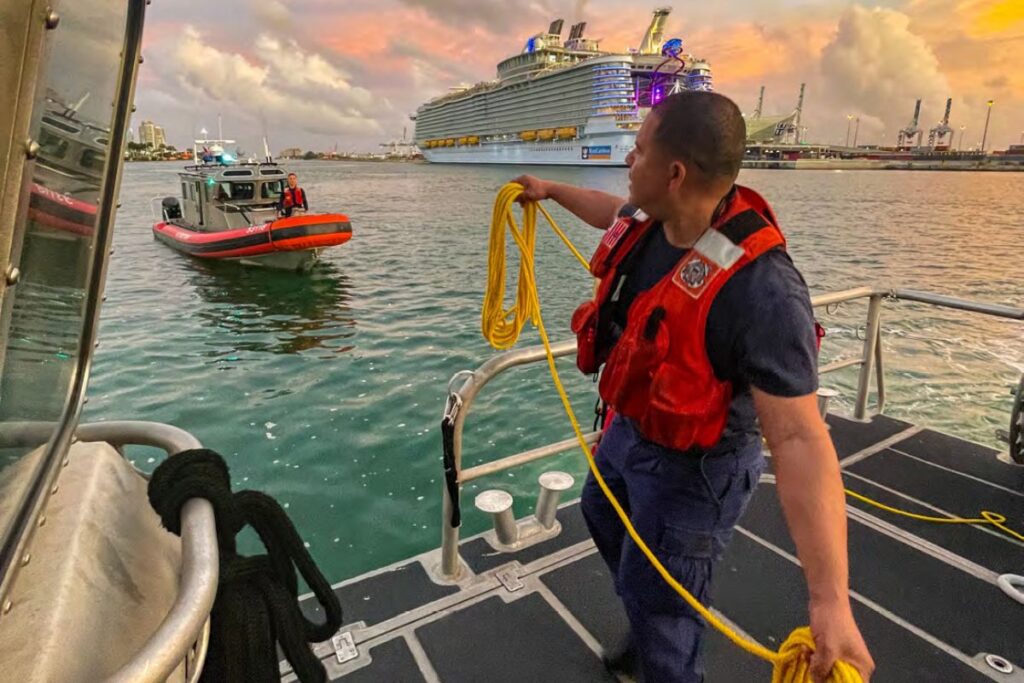
Coast Guard reservists conduct boat operations in support of maritime safety and security inside the
nation’s port environment. Across the entire year, reservists expanded operational presence to strengthen the Marine transportation System, increase maritime domain awareness, and reinforce port security during periods of heightened demand. (U.S. Coast Guard photo by Petty Officer 1st Class Rachael Greene)