By Sgt. Maj. Steve Minyard, USA (Ret.), ROA Director of Programs
Empowering our members to thrive in today and tomorrow’s Reserve.
Since 1922, ROA has fought for holistic benefits that enable our current and former members of the Reserve Components to thrive. ROA’s battles include successful campaigns for drill pay, a Reserve Component retirement system, and health care benefits such as TRICARE Reserve Select. Complementing ROA’s advocacy are programs designed to complement these benefits or fill gaps that neither Congress nor the Pentagon will fix. “Administrative friction,” a creaking, obsolete pay system, regulations and policies that ignore the nuances of Reserve life, and increasing demands for your time outside of drill all throw absurd barriers to successful service. ROA’s Vision 2029 seeks to change that.
ROA’s Vision 2029 supercharges our programs with one clear mission: empower our members to succeed. What does an “empowered” Reserve member and family have? To answer this question, ROA reviewed years of data collected from surveys, demographic reports, exit surveys from Reserve service, trends in litigation and Congressional action, and simple queries on social media from service members and families looking for help. We talked to veterans and service members and combined these with the centuries of experience within the ROA staff and membership. In short, we took a data-driven, people-focused approach. Some data surprised us, like the fact that thousands of Reserve Junior Enlisted members pay their entire drill pay, an average of $500.00, for a weekend of child care, or that the average Reserve member spends nine hours a month without pay working unit business. Other data points were shocking but not at all surprising, like activated members waiting months in Poland for duty pay or an estimated 50% rate of underemployment for Reserve Enlisted members with bachelor’s degrees.
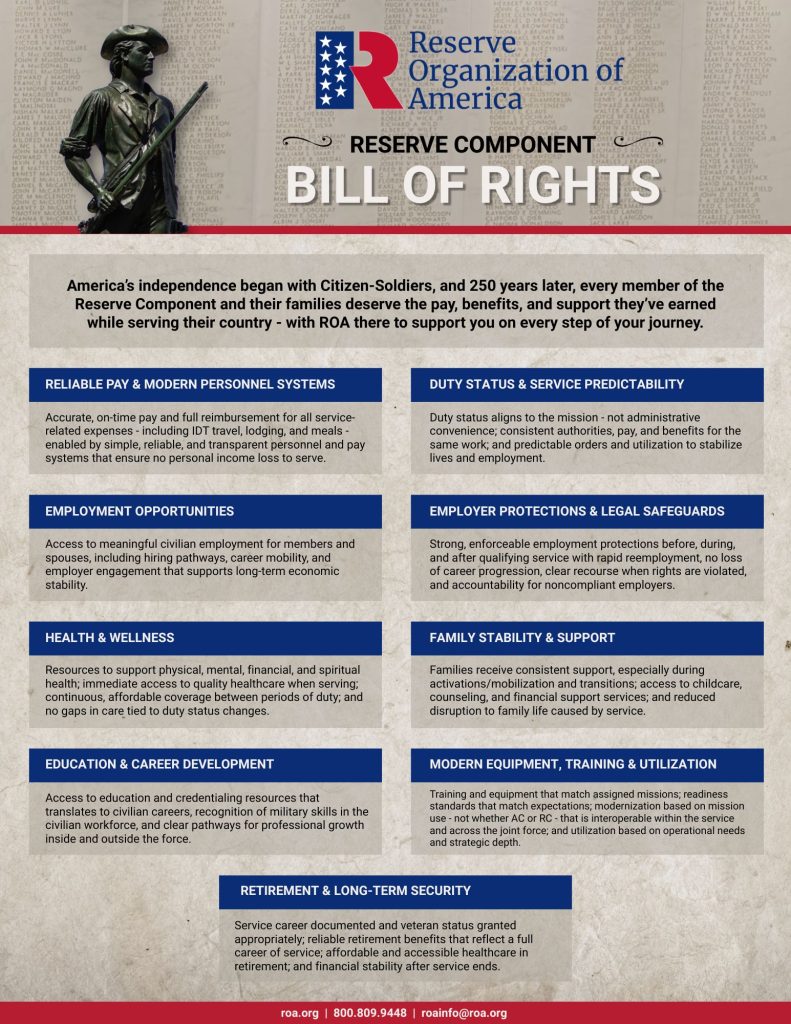
“Empowered” means easy access to all the benefits of the service. Timely, accurate pay, after drill, after annual training, and after mobilization or deployment. Full employment, leveraging civilian and military skills, and armed with protections under the Uniformed Services Employment and Reemployment Rights Act (USERRA). Compensation for working hours each month outside of drill, or when sitting at home on a laptop completing online training. An empowered Reserve family doesn’t spend their entire drill pay on childcare each month, or face sticker shock from the cost of TRICARE once they retire. Finally, veterans and retirees of the Reserve Components should have the full benefits of their service too, including a retirement health insurance system that rewards, not punishes, a Reservist’s step into the Retired Reserve. They have ready access to resources to supercharge their education, health, family life, and employment, and strong advocacy on Capitol Hill and within the Pentagon, plus the know-how to join ROA in the fight. In short, they have what their service entitles them to—all in ROA’s Reserve Component Bill of Rights.
These are not just words on a page; a battery of resources that ROA will deploy later this year backs them up, moving our Reserve Component members and families closer to the right’s fulfillment. First, we are building an entire system, ReserveConnect, to plug current and former Reserve service members into the employment, health, family, and education resources they need to thrive. Artificial Intelligence tools for Reservists looking for employment, scholarships, and new partnerships with world-class universities that offer flexible, career-enhancing certificates and degrees; the first Reserve Component-focused transition program and Noncommissioned/ Petty Officer Academy in history. Combined with world-class advocacy, ROA will sprint through 2026, ready to empower the next 250 years of America’s Total Reserve!
The Reserve Component By the Numbers
Data drives ROA. Here’s a window into today’s Reserve force.
- 0: Number of TAP-like programs designed for the 78,533 Reserve Component members who leave active military service.
- 8%: Rate of Reserve Component spouse unemployment, double the national average.
- 9: Average number of hours Reserve Component members spend working unit business each month, without pay
- 30: Average age of an Enlisted member of the Reserve Component
- 40: Average age of an Officer in the Reserve Component
- 247: Space Force “Guardians on Non-Sustained Duty” (GNSD), the first Reserve members of the U.S. Space Force, accessed in April 2026
- $310.51: Average loss in income, every month, to families with Reserve Component members working for free
- $500: Average cost for weekend childcare, as well as the entire average drill pay for a Reserve E-4
- $765.00: Annual enrollment fee for active-duty retirees in TRICARE Prime
- $1,548.30: Monthly premium for TRICARE Retired Reserve for a Grey-Area Retiree and their family
- 24,000: Estimated number of Reserve Component service members unemployed and searching for civilian jobs
- 60,703: Single parents actively serving in the Reserve Components
- 78,533: Reserve Component members leaving service-going to fully civilian life, to the Retired Reserves, or transferring into the Individual Ready Reserve (IRR)
- 190,931: “Grey Area Retirees” awaiting payment for 20 years or more of Reserve Component service
- 887,107: Family members of Reserve Component service members
- $6 billion: Annual costs, borne by Reserve Component members, for unpaid work and travel expenses related to their military duties.
The Reserve Enlisted Force
250 years securing America. Join ROA and build 250 more. The roots of today’s Reserve Enlisted force run deep. Before the founding of our Nation, before there was an Army or Navy, non-commissioned “private” service members stood ready, muskets in hand, to defend their communities. Our oldest Reserve force, the Army National Guard, traces its lineage over a hundred years before America’s founding, and the first shots of the American Revolution came not from “regular Army” troops, but a Reserve militia force led by Captain John Parker, whose visage is on the seal of America’s Army Reserve. Parker gets his due share of attention for actions on Lexington Green on April 19, 1775, but few know it was his sergeant, William Munroe, who brought Parker’s company to the battlefield to face British troops.
Between daylight and sunrise, Capt. Thaddeus Bowman rode up and informed that the regulars were near. The drum was then ordered to the beat, and I was commanded by Capt. Parker to parade the company, which I accordingly did, in two ranks, a few rods northerly of the meeting-house.
—Testimony of Sergeant William Munroe, Middlesex, March 7, 1825 Elias Phinney, History of the Battle at Lexington on the Morning of the 19th April, 1775
Munroe then stood with Parker as the battle commenced-officer and NCO, together woven into a fight that led to our independence. If you wear stripes and serve our Reserve force, that moment lit the fire for progressively more pay, benefits, and opportunities for us all-a fire ROA continues to fan today.
An educated force-ready for more
Over 800,000 men and women serve in America’s Reserve Enlisted force, over 83% of the total Reserve population. Army National Guard Specialists and Corporals (E-4s) make up the largest part of this force, nearly 100,00 Soldiers—a force larger than many nations’ armies. The rarest Enlisted Reservist, as of the Pentagon’s last report, was a single Seaman Recruit (E-1) in the Coast Guard Reserve. Since 2005, the Reserve Enlisted force has become more diverse, younger, and more educated year over year. As a percentage of the force, three times as many Enlisted members hold advanced degrees, for example, as they did in 2010. Today’s Noncommissioned and Petty Officers have more education, firepower, and benefits than Orderly Sergeant Munroe could have dreamed of, but much work remains.
What we know
In the last publicly available Reserve Component Status of Forces Survey, Reserve members spent an average of nine hours, a full workday, a month on “unit business” without pay. For a Reserve Marine, Sailor, or Airman, that’s over $200 in lost income. Moreover, some enlisted members pay their entire drill pay just for weekend childcare, or on travel during drill due to inane Joint Travel Regulation provisions. For years, the Pentagon has touted the success of its Transition Assistance Program (TAP), but for the 75,000 Reserve enlisted members who leave the force annually, there is no such program. Moreover, the underemployment rate of Reserve Enlisted members, where one unwillingly either works for less, in lower-skilled civilian jobs than they could, or works only part-time, could be as high as 50%. An estimated 24,000 Reserve members are unemployed. Most of these are enlisted members, with younger Reserve members having the highest unemployment rate of over 6%, much higher than the national average.
What we will do
ROA represents all the Reserve force, over one million service members, most of whom are enlisted. Through 2026, ROA will build several new programs under our ReserveConnect enterprise to fill gaps where we can and continue our advocacy with Congress, the White House, the Pentagon, and the Supreme Court to ensure the Reserve Enlisted force is empowered and thriving.
We are pursuing the United States’ joining, as full members, of the Interallied Confederation of Reserve Non-commissioned Officers (CISOR), giving our Reserve Enlisted force a gateway to international education, competition, and training. We are building a Joint NCO/PO Academy, designed to provide a baseline of information every Reserve Enlisted member should know, including how to operate in both military and civilian worlds and get the benefits you’ve earned in service. This Academy will be augmented with a Reserve Transition course that will fill a massive gap in education and teach, among other topics, the importance of the new DD 214-1, employment/reemployment rights, TRICARE options, ROA-sponsored options for supplemental insurance, and the universe of benefits, whether retiring or simply leaving Reserve service. We are working with partners such as AI Ready Veteran and VetJobs to connect Reserve members with Reserve-friendly employers. We find it appalling that so many Reserve Enlisted members are giving all their drill pay to child care and are exploring how to help. Finally, to help supercharge the Enlisted force’s higher education, we are partnering with world-class universities such as the Johns Hopkins Carey Business School and Norwich University to offer scholarships and opportunities to collaborate on research.
Much work remains. Today’s Reserve Component Enlisted force is not simply a strategic reserve waiting for the drumbeat to arms. They are day-to-day architects of American security, bringing their hard-won skills and adaptability to every formation, business, classroom, and boardroom. They are, without question, the most capable and versatile Enlisted Reserve force in history.
It’s ROA’s honor to serve you at home and abroad.