
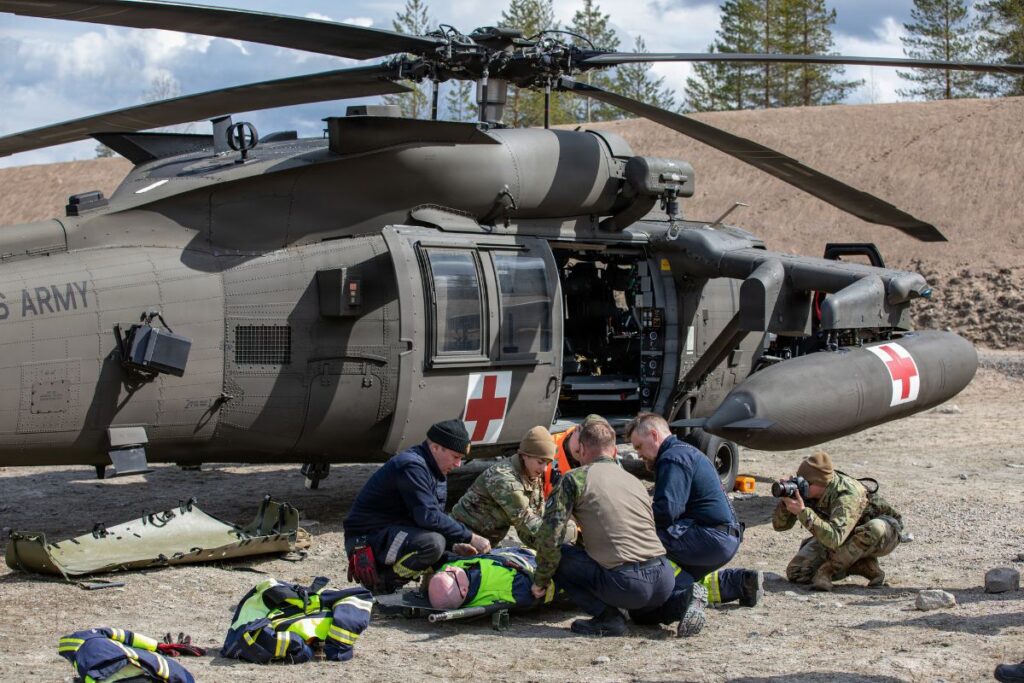
U.S. Army Reserve photo by 1st Sgt. Austin Berner
ROA has submitted its formal views to the Senate Armed Services Committee (SASC) on the FY 2027 National Defense Authorization Act (NDAA) as reported by the committee, backing provisions that preserve Reserve Component force structure and combat medical capability while raising concerns about a proposed rescoping of drill travel reimbursement.
The letter, signed by ROA’s Chief Executive Officer Maj. Gen. (Ret.) John B. Hashem, U.S. Army, was sent to SASC Chairman Roger Wicker, Ranking Member Jack Reed, and committee staff. The House has passed its version of the FY 2027 NDAA. The Senate has not yet taken up its version of the bill on the floor, and the two chambers have not yet gone to conference.
“The committee got a great deal right for the Reserve Components in this bill, particularly on preserving dedicated aeromedical evacuation and the aircraft inventories our members depend on,” Hashem said. “Where we have concerns, as we do with Section 601, we have said so plainly and we remain ready to work toward a balanced solution. ROA’s job now is to make sure the strongest provisions from both chambers survive conference.”
What ROA supports
ROA endorsed the committee’s procurement provisions sustaining critical force structure, including Section 133’s multiyear procurement authority for the F-15EX and Section 138’s extension through 2028 of National Guard C-130 inventory floors and divestment protections.
ROA also backed Section 745’s annual large-scale combat casualty estimation report, arguing that realistic casualty projections for a peer fight will demonstrate why a robust, dedicated aeromedical evacuation enterprise is indispensable, and Section 747’s expansion of health care license portability for National Guard medical providers under Title 32.
The organization further welcomed the committee’s items of special interest on Duty Status Reform and on the timing of TRICARE Reserve Select eligibility for members transitioning to the Individual Ready Reserve.
Section 742 and the campaign to preserve Army Reserve MEDEVAC
The letter singled out Section 742, which requires the Army to maintain an aeromedical evacuation capability along with the necessary personnel, training, doctrine and aircraft. ROA noted that Section 742 mirrors much of Sen. Ted Cruz’s RESCUE Act (S. 1951), which ROA supports, and that it complements two related House provisions: a prohibition on divestment of the Expeditionary Combat Aviation Brigades (ECABs) and a required Secretary of the Army report on the Army Transformation Initiative (ATI). ROA will advocate for all three provisions in the final bill.
Section 742 is the latest milestone in a sustained ROA campaign anchored in a resolution approved by ROA’s membership at the 2025 Annual Meeting calling for the preservation and modernization of Army Reserve MEDEVAC. Over the past year, ROA has engaged the offices of Sen. Cruz and Rep. Morgan Luttrell along with the professional staffs of the Armed Services and Defense Appropriations committees to reverse the MEDEVAC reductions embedded in ATI.
That campaign gained ground in May, when Secretary of War Pete Hegseth told the House Appropriations Subcommittee on Defense that parts of ATI warranted another look and that a review would follow, after Ranking Member Rosa DeLauro pressed on the aviation cuts in the FY 2027 budget request. ROA wrote to Secretary Hegseth thanking him for that commitment and underscoring that Army Reserve MEDEVAC must be central to the review.
In July, ROA welcomed the introduction of the Prohibit Deactivation of the ECABs Act of 2026 by Reps. Luttrell, Jeff Crank and Derek Tran, bipartisan legislation limiting the use of funds to deactivate the Army Reserve’s ECABs. The Army plans to deactivate the brigades on Sept. 15, 2026, though no replacement capability is expected before 2030 at the earliest. ROA has argued that divesting MEDEVAC without a follow-on platform accepts unacceptable operational risk, degrades the industrial base built around sustaining Army rotary-wing MEDEVAC, and forces out the soldiers, pilots and maintainers whose expertise cannot be reconstituted on demand.
“The ECABs are where the Army Reserve’s MEDEVAC mission lives,” Hashem said when the ECAB bill was introduced. “This is about more than an aircraft. It is about an industrial base, and it is about the soldiers, pilots and maintainers whose expertise in this mission set we cannot rebuild overnight once we let it go.”
With Section 742 in the Senate bill and the ECAB and ATI reporting provisions in the House bill, ROA said the conference committee now has every tool it needs to halt an irreversible action while the Secretary’s review runs its course.
Where ROA raised concerns
ROA issued concerns with Section 601, which narrows the travel reimbursement authority under Section 452(j)(1) of Title 37 as amended by the FY 2025 NDAA, delays implementation from Jan. 1, 2027, to Jan. 1, 2028, and requires a cost estimate on the narrowed authority by Sept. 30, 2027. ROA called that a premature rescoping of a benefit that has never been funded or tested, and urged Congress instead to direct a study of the full authority’s cost, disaggregated by component and developed in collaboration with each of the Reserve Components.
ROA emphasized that it remains open to finding a balanced approach with the committee and the Department as the bill moves forward. The organization will also seek a more in-depth assessment of Reserve Component pay and benefits as part of the next Quadrennial Review of Military Compensation, so that decisions about drill travel reimbursement and related authorities rest on a complete accounting of how the compensation system serves citizen-warriors and reflects modern-day reserve service.
ROA also expressed disappointment at the absence of a Senate companion to House Section 702, which provides cost-free dental care access for junior enlisted members of the Selected Reserve. ROA views the House language as a reasonable, cost-conscious compromise on a long-standing readiness gap, since dental disqualifications remain a leading cause of non-deployability among drilling reservists, and urged its acceptance in conference.
Finally, ROA urged caution on any consolidation or joint use of Army Reserve and Army National Guard facilities, noting its opposition last year to a provision that would have disestablished the Navy Reserve’s entire Readiness Center infrastructure. Any such arrangement, ROA wrote, must rest on an equitable framework ensuring neither component is subordinated to the other in basing, stationing and facility decisions.
ROA will meet with committee professional staff on Sept. 23 to discuss the path forward and will report further developments as the FY 2027 NDAA moves toward conference.