
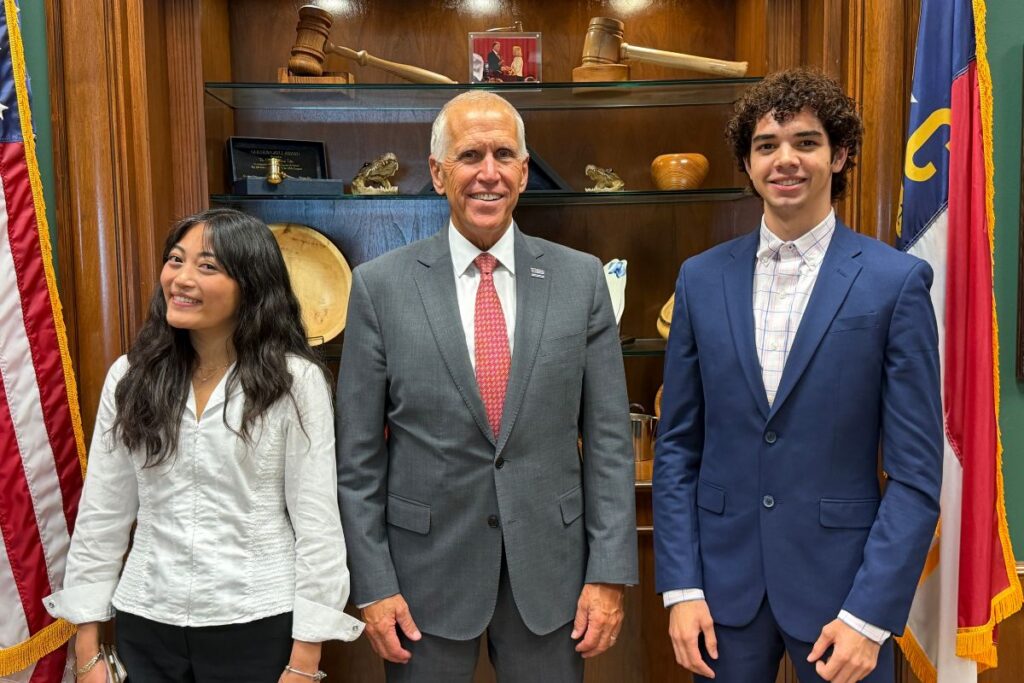
I came to Washington expecting to make coffee.
That is not cynicism, it is experience. My previous internship, with the Utah State Legislature, ran to the stereotype: coffee runs, filing cabinets, the quiet dignity of a well-organized binder. I assumed a government affairs internship in Washington, D.C., would be more of the same, only with worse traffic and parking. Then the Reserve Organization of America handed me the FY27 National Defense Authorization Act and asked what I thought of it.
The NDAA is not a bill so much as a weather system. It is enormous, it touches everything, and it changes shape depending on where you are standing. Learning to analyze it was perhaps the most valuable skill I built this summer. I learned to move through hundreds of pages of statutory text with a purpose, to isolate the provisions that “touch” the Reserve Components, and to read a section not just for what it says but for what it does to a population the drafters may never have pictured. Yet, analysis was only the entry point. I also learned to draft.
Writing legislative language is a different discipline entirely, and a humbling one. Analysis rewards breadth; drafting punishes imprecision. A single undefined term or a poorly bounded eligibility clause can quietly exclude thousands of people, and there is no way to hedge your way out of it. Working on proposed language taught me to think in terms of statutory mechanics rather than intent, which is the difference between a policy that sounds right and a policy that functions.
From there the work moved up the chain. I developed briefings and policy recommendations intended for senior leaders and decision makers, which meant compressing weeks of research into something a principal could absorb in three minutes and act on with confidence. That compression is its own craft. It forces you to know the material well enough to decide what to leave out, to lead with the recommendation rather than build to it, and to anticipate the first question rather than the fifth.
What made all of it real was proximity.
Over the course of the summer, I sat in on meetings of The Military Coalition and with congressional staff, including one with a reservist who works on the Senate Veterans’ Affairs Committee, and watched national security and congressional leaders negotiate in real time over sequencing, scope, and cost. The tension between the Major Richard Star Act, the Take Care of America’s Veterans Act, and blast overpressure legislative language is not an abstraction when you are in the room while it is being worked out. It is faster than it looks from the outside, and far more collaborative. Yet somehow, it also turned out to be familiar. My legislative priorities have always centered on indigenous rights and health equity, and I did not expect military policy to be where those priorities lived. It is. Veterans’ health policy, for example, is health equity, argued in a different dialect.
Some of the education happened in hallways rather than conference rooms. Alongside my colleague Hayley, I hand delivered invitations to ROA’s America 250 Minuteman of the Year Award Ceremony, crossing the Hill office by office and asking for two minutes of a staffer’s afternoon. My favorite stop (if I had to choose one) was Senator Schatz’s office, where I met two staff assistants who had graduated within the past two years. For one of them, it was her first job out of school. Standing in that front office, the distance between where I am now and where they are collapsed to almost nothing. I left with their contact information and the beginnings of an actual professional relationship, which was the assignment’s real payload.
Shadowing Matt Schwartzman, ROA’s Director of Legislation and Military Policy, showed me the second seat at the table. I had always been told that holding office, or staffing someone who does, is how underrepresented communities finally get heard. Working the outside game offers different leverage: the freedom to specialize deeply, and to represent people whose needs are too specific to survive a general audience.
Because they do get lost. I watched it happen.
That gap is not malice. It is bandwidth.
In the first meeting I ever witnessed between ROA and a congressional office, the staffer said plainly that Duty Status Reform was not an area known well. Staff cannot be subject matter experts in everything, which means someone has to arrive already knowing, already carrying the fix, already able to explain in five minutes why thirty duty statuses is not a rounding error. I had never once considered that as a career. I am considering it now.
One underrated element deserves its due: the food. Washington runs on it, and so does this team. Cups was our most frequented spot by a wide margin, the default answer to almost every question about where we were headed, and a fair amount of what I learned this summer I learned standing in line there rather than sitting at my desk. Institutional knowledge does not travel through email. It travels sideways, in the ten minutes between the office and the counter, and being included in those ten minutes is how an intern stops being a visitor.
My summer at ROA ranged from handing an award to former Speaker Rep. Nancy Pelosi to hustling across the Hill with a stack of invitations and a rapidly failing pair of shoes. I leave with a working method for legislative analysis, real drafting experience, the ability to write for a principal rather than a professor, and a network I did not previously have.
Learning what Reserve and National Guard servicemembers actually face, and then translating those disparities into something Congress can act on, is a genuine craft. It is social capital, political strategy, and stubborn technical expertise, all at once. I am disappointed that my time with ROA is ending. However, I am encouraged that this is now the arena I want to spend my career in.