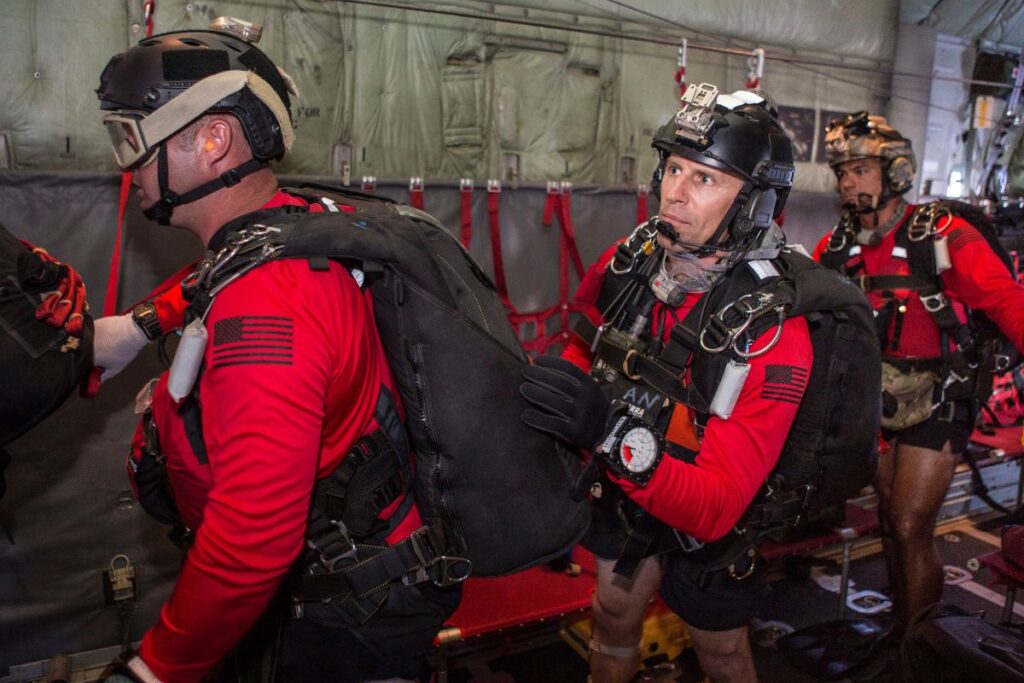
Guardian Angel Airmen on board an HC-130P/N King fixed-wing aircraft from the 920th Rescue Wing were part of concerted rescue effort of approximately 80 wing personnel and four wing aircraft that rescued two German citizens in distress at sea July 7, 2017 and into July 8. The victim’s vessel caught fire approximately 500 nautical miles off the east coast of southern Florida. At the request of the U.S. Coast Guard’s Seventh District in Miami, the 920th RQW was alerted by the Air Force Rescue Coordination Center at Tyndall Air Force Base, Florida, to assist in the long-range search and rescue. Approximately 80 wing Citizen Airmen and four wing aircraft helped execute the rescue mission to include, maintenance, operations and support personnel. (U.S. Air Force photo by Master Sgt. Mark Borosch)
By Lt. Gen. John P. Healy, Chief of Air Force Reserve, and Chief Master Sgt. Israel Nuñez, Senior Enlisted Advisor to the Chief of Air Force Reserve and Command Chief Master Sergeant of Air Force Reserve Command
This year, as our nation celebrates its 250th anniversary, we are reminded of a core principle of our republic: a nation defended by its citizens. That principle defines the character of today’s Reserve Airman, one of innovation, perseverance, and the selfless desire to serve. That legacy, combined with the lessons observed over 25 years of continuous combat operations, forged our capability and combat-proven experience. This has evolved into what we call the Reserve Advantage, a strategic edge with five core pillars: Fly, Fix, Fight, Warrior Culture, Surge Capacity, Strategic Depth, and Force Mix Optimization. These pillars of the Reserve Advantage were foundational then, are indispensable now, and will be decisive tomorrow.
Then: The origin of our advantage was from a strategic choice made at our nation’s founding. The model of a professional military augmented by a part-time citizen force was our country’s first and most enduring force mix. It was a deliberate design born of necessity, built to provide efficiency, strategic depth and surge capacity to execute in response to crisis at a moment’s notice. As our full-time support responsibilities increase to meet today’s operational reality, we must optimize our force without sacrificing the part-time structure that is the very source of our experience and strategic depth. I’m talking about the Air Reserve Technician (ART) program, which is valuable for its technical continuity but lacks the flexibility and agility we need in a potential fight-tonight scenario. We must shift our full-time status to match today’s warfighting requirements by increasing our Active Guard Reserve (AGR) end strength. To execute, we need congressional support for relief from the current ART floor and the current AGR grade ceilings and end-strength limitations, making this one of our top legislative priorities.
From the enlisted perspective, the character of our Reserve Airmen is defined by the values that have been passed down through the NCO corps for 250 years: perseverance in the face of overwhelming odds, integrity when no one is looking, and the grit to see the mission through. Adhering to these values is what makes the difference between a job and a calling. Our enlisted members answer that call, and they prove it through the relentless reps and sets of training and development to be the most competent leaders our Airmen deserve. That deliberate choice to serve, to be ready at a moment’s notice while balancing two demanding careers, is the foundation of our professionalism. This deep commitment to the mission is why so many of our Airmen choose to stay, some even serve an entire career in one unit. They become the source of our strategic depth, routinely training new generations of aeromedical evacuation operators, mentoring Airmen in our smaller communication flights, and managing the complex, high-stakes flow of cargo and passengers in our busy aerial port squadrons. It is a legacy our enlisted force proudly carries forward into the future fight.
Now: The Reserve Advantage is defined by our role as a fully operational force, providing daily combat capability to meet global demands. We saw this in real time during the recent crises that triggered Operations MIDNIGHT HAMMER and EPIC FURY, where our Reserve airlift and tanker crews were airborne within 72 hours, providing critical surge capacity. This operational reality places us at the center of the Air Force’s primary strategic challenge: balancing readiness today with the modernization required for tomorrow. Our advantage is what makes navigating this tension possible. It is the efficiency of our force structure, like a Reserve F-16 unit that operates at $12 million less per year with pilots who are three times more experienced, that frees up resources for modernization. At the same time, it is the strategic depth of our Airmen that preserves our lethality. A prime example comes from our 960th Cyberspace Wing. Our combat communications professionals are at the cutting edge of the counter-unmanned aerial systems fight. They recently proved this by successfully implementing a $46M Combined Defense Operations Center for Operations FREEDOM SENTINEL and JUNIPER SHIELD. This highlights the core dilemma: we have some of the most experienced operators in the joint force, but their effectiveness is limited by the tools we give them. That is why we must make hard, deliberate trade-offs to modernize. This is not just about aircraft such as the KC-46, F-35, and B-21. It is also about investing in the advanced expeditionary command-and-control capabilities our warfighting communicators need. These are the tools we need to sharpen the Reserve Advantage across every domain, and they are how we stop preparing for the last war and start winning the next one.
Our enlisted force not only executes the mission to the same Fly, Fix, Fight standard as the Regular Air Force, they go beyond it. The fact that many of our Reservists are part-time does not mean half as good, and what sets us apart is our experience, our depth, continuity, and technical competency that we bring from our civilian occupations into military service. This expertise translates into innovation that helps us solve some of the Air Force’s most pressing parts-availability and supply chain problems. Just recently, Reserve maintainers at the 349th Maintenance Group at Travis Air Force Base took action when critical C-17 parts failed due to heat-induced warping. Their in-house team designed, prototyped, and printed a durable replacement that, after a six-month evaluation, showed zero defects and is now implemented fleet-wide. We see that same experience and judgement at work when they have the opportunity to live the commercial that they joined us for in high-impact, real-world missions whether its operating a boom and refueling a fighter over the Pacific from a KC-46, performing life-saving rescues as part of a Guardian Angel team or setting up a communications suite from scratch in a bare field less than 72 hours from leaving their homes and civilian careers. These are just a few examples of the experience and commitment that does not exist outside the Reserve, and our Airmen prove day in, day out that they are ready, they are force multipliers, and they are an advantage.
Tomorrow: We will win by deliberately shaping a more lethal, agile, and interoperable force. We are moving out along two main lines of effort: transitioning to the new Air Expeditionary Wing (AEW) 2.0 and strengthening our alliances abroad with the Reserve Allies and Partner Program (RAPP). As an inherently mission-focused and efficient force, the Air Force Reserve is already structured to present Units of Action AEW 2.0 rapidly. This model emphasizes small, adaptable teams that can generate combat power from a network of dispersed, survivable locations, anytime, anywhere. Through our second line of effort, RAPP, we are turning handshakes into partnerships. We have moved from initial engagements to signing formal agreements with both the United Kingdom and France, and another bilateral agreement for the Netherlands is on the way and currently under legal review. Courses like the Base Defense Leadership Course will become a common standard for coalition forces, not an exception. Future exercises like STEADFAST DEFENDER and PATRIOT MEDIC will see even deeper integration, testing our combined forces against the most demanding future scenarios. By building partner capacity and increasing tactical interoperability, we are not just sharing the burden; we are multiplying our combat power.
A future force is only as strong as its people, and advanced platforms are only as effective as the professional, combat-ready Airmen who operate them. Our focus is on investing in you, our greatest advantage, through a deliberate talent management strategy that honors your commitment and unleashes your full potential. First, we are breaking down rigid career-field stovepipes to create broader, more adaptable Airmen ready for the complexities of the future fight. Second, we are re-engineering our promotion system to be transparent, repeatable, and defendable, ensuring we elevate the right leaders for their leadership and competencies. And finally, we are clearing a path to a commission for our highest-performing enlisted members, because we cannot afford to lose our next generation of leaders to bureaucracy. All these efforts are underpinned by our commitment to building a stronger community of support.
The lesson of our nation’s 250th anniversary is clear: the complex readiness and modernization challenges we face demand we build the agile, lethal, and combat-credible force we need for tomorrow. This model is about people, the Reserve Airmen who have made the conscious choice to serve. That choice, the personal commitment to balance a civilian life with the defense of our nation, is the source of our discipline and our professionalism. That choice is the source of our true Reserve Advantage. We have the responsibility to honor that choice by ensuring they are equipped with the best training, resources, and modern tools to win in the decades to come.

Lt. Gen. Dominique Tardif, left, Vice Chief of the French Air and Space Force, and Lt. Gen. John Healy, right, Chief of the Air Force Reserve and Commander of Air Force Reserve Command, convened in Paris, France, on Friday, September 12, 2025. During the meeting, the leaders signed Terms of Reference between the French Air and Space Force and the United States Air Force Reserve, formalizing their commitment to bilateral cooperation and reflecting shared values, priorities, and operational goals. (U.S. Airforce photo by Master Sgt. Nicole King)