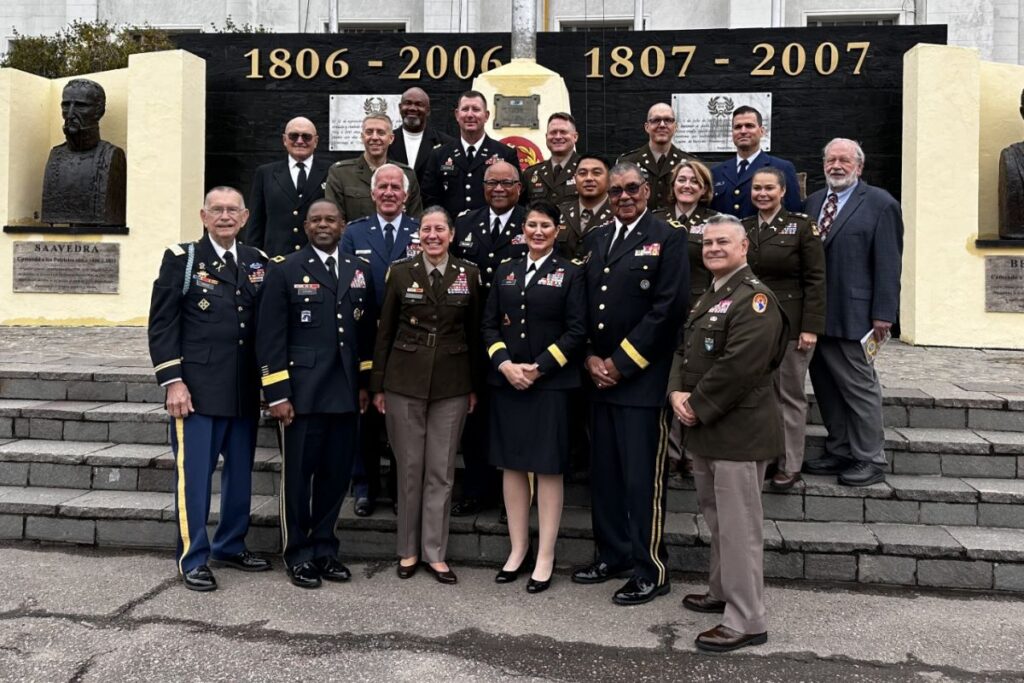
UPORFA in Lima, Peru, 2024 (Photo courtesy Brig. Gen. Irene Zoppi, USA (Ret.), M.D.)
By Brig. Gen. Irene Zoppi, USA (Ret.), M.D.
In an era of shifting global security landscapes, the role of the military reservist has never been more critical. The Western Hemisphere stands as a unique bastion of shared democratic values and collective security, but that strength does not sustain itself. It is built and reinforced through deliberate cooperation, and at the center of that effort sits the partnership between the Reserve Officers Association (ROA) and the Unión Panamericana de Oficiales de Reserva de las Fuerzas Armadas (UPORFA). Together, they form a pan-American network that connects citizen-soldiers across North, Central, and South America and turns that connection into real capability.
UPORFA serves as a vital bridge between nations, fostering cooperation, democratic values, and the professional integration of reserve forces across the hemisphere. This is not a passive forum. It functions as an engine for interoperability. By bringing together reserve officers from across the Americas, it ensures that citizen-soldiers are not treated as a secondary force, but as a modernized, highly capable component of national defense. ROA, as the U.S. representative to UPORFA, extends its mission beyond domestic advocacy to this broader hemispheric framework, ensuring American reservists remain connected to a broader operational and professional ecosystem.
The strategic importance of this relationship sits in plain view. The Western Hemisphere is more than geography. It is an interconnected system of economies, cultures, and security interests that directly impact U.S. prosperity and stability. ROA’s mission to support America’s Reserve and Guard components extends through UPORFA into democratic nations from Canada to Chile and across the Caribbean. That reach strengthens collective defense, improves disaster response, and enhances efforts to counter narcotics trafficking and other transnational threats. Reservists bring flexibility, civilian-acquired expertise, and local understanding that active forces alone cannot replicate. When aligned across nations, that capability multiplies.
ROA’s legacy, defined by a century of service to America, reinforces this effort through advocacy in Congress and engagement with the Department of Defense. That advocacy ensures policies match the reality of how reserve forces operate today. At the same time, UPORFA builds the relationships and shared understanding that make those policies executable across borders. The result is a system in which strategy, policy, and operational capability reinforce one another rather than competing for attention.
The Citizen Soldier model sits at the core of this system. ROA members and their UPORFA counterparts embody the “twice the citizens” concept, maintaining civilian careers while serving in uniform. That dual role strengthens the bond between the military and the society it serves. It embeds democratic principles directly into the force and reinforces the requirement that militaries remain subordinate to elected leadership. UPORFA expands that effect across the hemisphere by disseminating knowledge on reserve development, training, and professional networking. It allows reservists to share skills across borders, build trust, and return to their home units more capable than when they left.
The impact shows up in three areas that matter. Security cooperation improves as nations develop the ability to operate together during humanitarian crises and regional contingencies. Democratic stability strengthens as the principle of civilian control remains embedded across partner nations. Professional development accelerates as training and best practices spread across domains ranging from tactical medicine to cybersecurity. Each of these outcomes contributes directly to readiness.
That trajectory continues with the XXVI UPORFA International Congress, scheduled for September 2 to 5, 2026, in Buenos Aires, Argentina. This event places a deliberate focus on multi-domain operations and the integration of reserve forces into that fight. The modern battlefield does not operate in isolated domains. Land, sea, air, and digital environments function as a single system. Reserve forces must integrate into that system without delay, and this Congress addresses that requirement directly.
The gathering will bring together senior military leaders, academic experts, and reservists to confront the realities of modern warfare. Discussions will center on current capabilities, future challenges, and the structural adjustments required to make reserve forces immediately usable in complex operations. The inclusion of a Tactical Emergency Casualty Care course underscores the event’s practical nature. Training that saves lives in high-risk environments represents a baseline requirement, not a niche skill set.
Participation in this congress delivers clear value. It builds professional networks that extend across the hemisphere. It exposes participants to emerging technologies, including the integration of artificial intelligence into reserve operations. It provides access to high-level certification opportunities rarely available in a single venue. Most importantly, it strengthens the collective capacity of the reserve force by aligning perspectives and capabilities across nations.
ROA’s role in this effort connects its members directly to these opportunities. Membership does more than support advocacy. It places individuals within a network spanning the hemisphere and provides access to the relationships, training, and knowledge required to operate effectively in today’s environment. The connection between ROA and UPORFA ensures that American reservists do not operate in isolation but as part of a broader, integrated force.
The event will take place in Buenos Aires from September 2–5, 2026, with registration closing ahead of the event window. Registration for the congress is open at https://roa.org/event/uporfa2026/. This is not a passive event. It is a working forum where relationships are built, ideas are tested, and capability is strengthened.
A single nation or a single component will not write the future of defense in the Western Hemisphere. It will be shaped by networks of capable, connected Citizen Soldiers who understand both their national responsibilities and their role in a larger system. ROA and UPORFA provide the structure to make that possible. The responsibility now sits with those who serve to engage, contribute, and strengthen that system before the next crisis demands it.