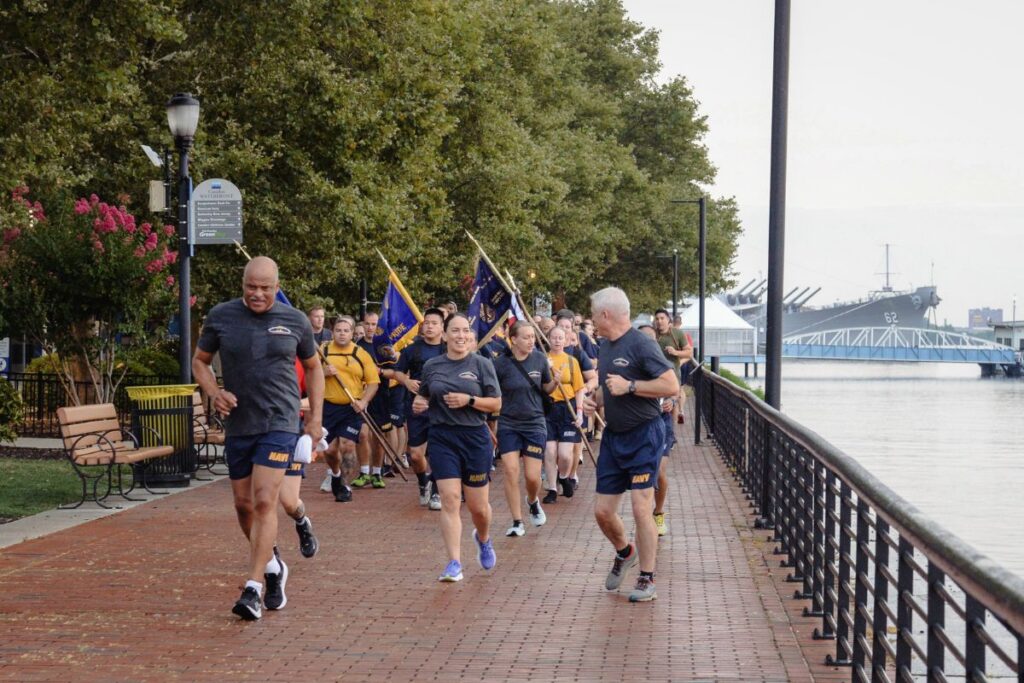
Navy Reserve Force Master Chief Nicole C. Rios, retired U.S. Army Chief Warrant Officer 5 Phillip M. Brashear, and Rear Adm. Jonathan R. Townsend lead 70 chief selectees across the Benjamin Franklin Bridge during the “Bridge Run” at Big J Heritage Academy. The annual tradition honors the Navy’s proud heritage and the collective strength of the Total Force Chiefs’ Mess. (U.S. Navy photo by Senior Chief Mass Communication Specialist Timothy Aguirre)
By Force Master Chief Nicole C. Rios, Navy Reserve (FORCM #18)
The 34th Chief of Naval Operations, Adm. Daryl Caudle, opened his Fighting Instructions with two words that carry the full weight of naval doctrine and personal conviction: Sailors First. While advanced platforms, logistics, and infrastructure are essential to naval power, the Sailor is the decisive enabler who makes all of it matter. The lifeblood of the Navy, in Admiral Caudle’s words, is the Sailor who is well-trained, connected, supported, and fit to fight. That is not an aspiration. It is a standard. And it is the standard against which everything I do as Force Master Chief of the Navy Reserve must be measured.
My role in this force is to ensure that every one of our 57,000 Selected Reserve (SELRES) and Training and Administration of the Reserve (TAR) Sailors is ready to answer the CNO’s call. Every single Sailor. To do that, I have organized my priorities around two imperatives that are as old as the Chief Petty Officer Mess and as current as the Fighting Instructions: Hone the technical competence of every Sailor, and develop their character. Together, they set conditions for success.
Then: The enlisted backbone and the standard that holds
The Chief Petty Officer Mess was formally established in 1893, codifying what the Navy had long understood: that technical mastery and moral authority, held together in the same pair of hands, constitute the most powerful leadership combination the sea service possesses. The chief is not merely a technical expert. The chief is the keeper of the standard. The chief is the one who looks a junior Sailor in the eye and says, without flinching: “This is who we are, and this is how we do things”. That transmission of standards, that deckplate presence that holds culture accountable, is what has kept the Navy ready across 250 years.
In the Reserve, that transmission is harder. Chiefs see their Sailors one weekend a month, two weeks a year. The opportunities to observe, coach, correct, and develop are compressed. The temptation to accept minimum compliance in place of genuine readiness is real. The chiefs who have resisted that temptation across the 111-year history of the Navy Reserve are the reason this force can mobilize and fight. They are the reason Reserve Sailors have been deployed to every major conflict since 1915, with skills the Fleet could use. They built readiness in the margins, with less time and fewer resources, and they held the standard anyway. That is the heritage we carry, and the obligation we owe to every Sailor now in our charge.
Now: Setting conditions across every level of leadership
The first target is Development and Investment. Professional and personal development at every level of leadership, sustained across a continuous training continuum, is the foundation of technical competence in this force. Sailor 360 is the framework I expect leaders to use, and I expect them to use it with genuine intent, not as a compliance exercise. The Culture of Excellence and Total Sailor initiatives are not programs layered on top of the mission. They are how we build the kind of Sailors the mission requires. Fit to Fight means exactly that: physical readiness, mental health, and personal resilience are not peripheral concerns. They are readiness conditions.
The second target is Management and Transitions. The right Sailor in the right billet at the right time is not a slogan. It is the operational definition of talent management in a reserve component. Every gapped billet is a readiness gap. Every Sailor who leaves because the transition process was broken, or because a career path was invisible, or because the system treated their expertise as interchangeable with someone else’s is a failure of the institution, not the individual. We are working to improve permeability between SELRES, TAR, and the active component, to strengthen onboarding so new Sailors understand their purpose from the first day they arrive, and to build deliberate career paths that make the connection between civilian expertise and naval warfighting mission explicit and navigable.
The third target is Sustainment and Recognition, which I frame as a simple equation: Quality of Service equals Quality of Life plus Quality of Work. Quality of Life means healthcare that works for members and families, weekend child care that allows a Sailor to attend drill without choosing between service and parenthood, and support services like the Returning Warrior Workshop and the Navy Reserve Mentorship Network that are funded and accessible, not merely listed in a catalog. Quality of Work means evaluations that are continuous and meaningful, a new CPO evaluation process that accurately reflects Chief Petty Officer performance, and a recognition culture that names excellence at every level, from the Sailor of the Year to the civilian activity of the year.
Character is the harder half of the equation, and for that reason, it is the half most often deferred. I will not defer it. The Navy Reserve Force Orders are professionalism, combat readiness, safety, leadership, and teamwork. They describe the character we expect every Sailor to embody, in that order, every day. Military bearing matters. Good order and discipline matter. Standards matter. The force lens I apply to every leadership decision asks three questions: What is the risk to force? What is the risk to mission? What is the risk to the individual? Those questions are simultaneous, not sequential, and they require a leader whose judgment has been deliberately built, not assumed.
The Chief Petty Officer Mess is where that building happens. The work we are doing on initiation standards, training plans, funding, and execution of heritage events, and non-participation accountability is not administrative maintenance of a tradition. It is the active cultivation of the force’s most important leadership multiplier. What we invest in the mess today will appear in the readiness of the force a decade from now. Collaborative learning across professional military training, professional personal education, character and leadership development is how we get there; not in sequence, not selectively, but together, at every level, from the most junior Sailor to the most senior Master Chief in the force.
Tomorrow: The human requirements of the Hedge Strategy
Each of the CNO’s four strategic imperatives — hedge aggressively, innovate continuously, fight distributively, command with clarity — describes the same underlying human requirement: a Sailor developed well enough to exercise sound judgment under pressure, without waiting for instruction. A platform or a program does not produce that Sailor; they are built by leaders who hold the standard at the deckplate, year after year, drill weekend after drill weekend.
The Enhanced Mission Command Framework that guides Hedge Strategy implementation makes this connection explicit. Delegated autonomy levels are tied to the authority granted to a unit’s demonstrated ability to sense, assess, and synthesize the operational environment. That ability is not a function of platform capability alone. It is a function of the people operating the platform: their training, their judgment, and their character under pressure. It cannot manufacture that development on demand. The work of building battle-ready sailors for a distributed maritime operations environment starts at the deckplate, with a Chief Petty Officer who holds the standard and a junior Sailor who rises to meet it.
Looking ahead, the emerging capabilities that define the Hedge Strategy’s tailored offsets, including robotic and autonomous systems, AI-enabled decision advantage, advanced manufacturing in contested logistics environments, and directed energy for terminal defense, are areas where the Navy Reserve’s civilian talent pipeline represents a genuine strategic advantage. Our Sailors work on these technologies in their civilian careers. The Reserve’s obligation is to develop that expertise into warfighting competence through deliberate career paths, operationally grounded training, and joint qualification requirements that connect civilian mastery to military mission.
The standard we keep
The CNO has said there is no secret to success: just resources, attention, and hard work. I would add one more element that makes resources, attention, and hard work sustainable across a force as complex as ours—character. A force whose leaders have character will find the resources it needs, apply the attention the mission demands, and do the hard work whether or not anyone is watching. A force whose leaders lack it will fail at all three, regardless of what the budget provides or what the instructions say.
The MCPON’s guidance, the CNO’s Fighting Instructions, and 133 years of Chief Petty Officer Mess tradition all arrive at the same conclusion: the quality of this Navy’s enlisted force is the quality of its senior enlisted leadership. Every chief who holds the standard, mentors the junior Sailor, and refuses to accept average is doing the work that no platform procurement can substitute. A force built to that same standard—across 57,000 billets spanning every warfare domain—is setting conditions under which the Hedge Strategy can succeed.
That is my commitment to this force. Hone the technical competence. Develop the character. Set conditions for success. Not for some Sailors; for every Sailor—every watch, every drill weekend, every deployment, every day.