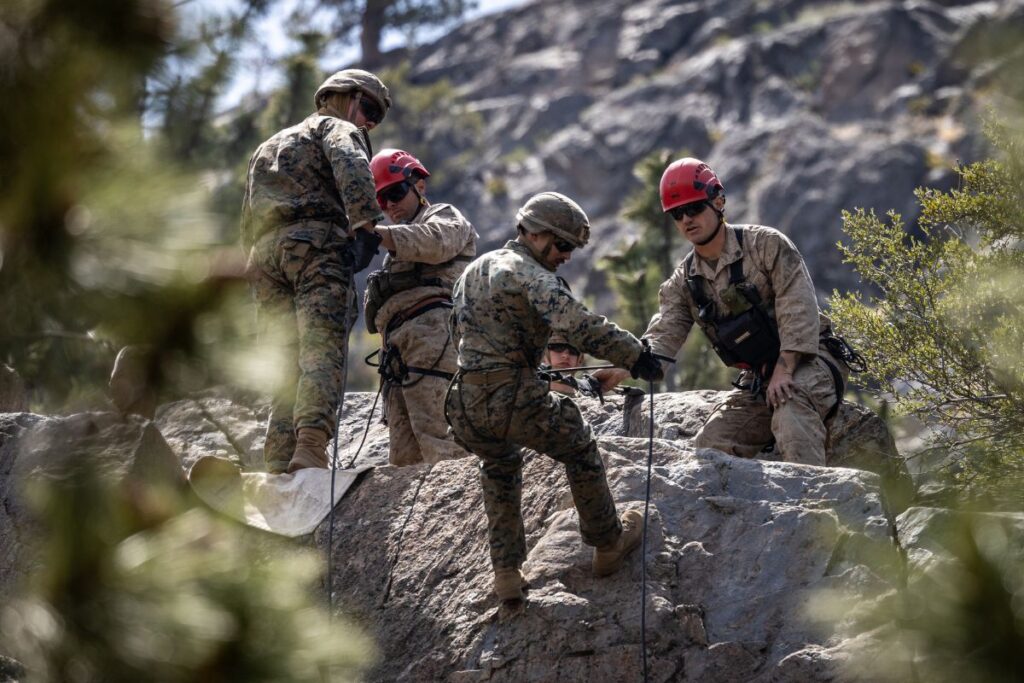
U.S. Marine with 2nd Battalion, 25th Marine Regiment, 4th Marine Division, repel down a mountainside during Mountain Training Exercise 4-24 at Marine Corps Mountain Warfare Training Center, Bridgeport, California, June 15, 2024. Marines traversed steep inclines and rocky outcrops to build their mountaineering proficiency in high-altitude maneuvers and navigation. MTX includes a variety of scenarios to test the Marines’ adaptability and resilience, simulating real-world environmental challenges they might face. (U.S. Marine Corps photo by Lance Cpl. David Intriago)
By Lt. Gen. Leonard F. Anderson IV and Sgt. Maj. Edwin A. Mota
We have the distinct and profound honor of leading the United States Marine Corps Reserve, a command that we believe represents the very best of our nation. It is a privilege we do not hold lightly, especially as we mark 250 years of American independence, borne through battle during the Revolutionary War, which included our founders, the Continental Marines.
We are fortunate to serve alongside a unique and remarkable cadre of Americans: the Citizen Marines. They are the warfighters of today—ready and able to deploy to any clime at any time. They are the high school history teacher who spends his weekends teaching machine gunnery, the trauma surgeon who drills on mass casualty evacuation procedures, the software architect who dedicates her analytical prowess to defending our networks, and the tradesman who leads a unit of infantrymen. They are remarkable Americans who walk in two worlds simultaneously, who on any given Friday afternoon might trade a business suit, a pair of work boots, or a doctor’s stethoscope for the Eagle, Globe, and Anchor, ready to answer the nation’s call. They masterfully balance civilian careers, demanding family lives, and vital community leadership with an unbreakable, unwavering commitment to our Corps and country.
As the senior stewards of this sacred trust, we wish to provide a comprehensive and deeply personal perspective on the state of your Marine Corps Reserve as framed entirely through the lens of the definitive roadmap that guided our every action, our every decision, and our every dollar this past year and into the future: The Marine Forces Reserve Campaign Plan for Comprehensive Readiness.
This plan was not conceived in an academic vacuum or a quiet staff college seminar. It was forged through a clear-eyed, sober assessment of a volatile and increasingly complex global security landscape. As the plan itself notes, we live in an era of renewed great power competition, facing pacing threats from the People’s Republic of China, an acute threat from a belligerent Russia, and persistent dangers from Iran, North Korea, and violent terrorist organizations. It is an environment that demands more, not less, from every component of our military. It was this stark reality that drove the creation of our Campaign Plan and established its central theme, our unwavering North Star, and our single, non-negotiable metric: our readiness is our relevance.
With this simple yet powerful declaration as our guiding principle, we embarked on a deliberate and institution-wide reorientation of our efforts to achieve, measure, and sustain comprehensive readiness across the entire force. The following is not just a report on our progress; it is the detailed story of how we translated the strategic imperatives of the Campaign Plan into the tangible, impactful results the nation expects and deserves from its Marine Corps, now and in the future.
At the very heart of our Campaign Plan, and thus at the core of our every effort this past year, is the formal and enthusiastic embrace of our evolved, dual identity. We remain the nation’s ultimate strategic hedge. This is our foundational, bedrock responsibility—the critical “break-glass-in-case-of-war” force that provides the essential depth of force and scalable mass required for a large-scale, high-intensity conflict. We are the promise to the American people that in their moment of greatest peril, a vast reservoir of trained and ready Marine formations stands ready to mobilize, deploy, and fight. Layered upon this bedrock, however, is our concurrent and continuous role as an operational Reserve. We are an indispensable, fully integrated component of the Total Force, actively and meaningfully engaged in global missions every single day.
These two roles are not in tension; they are symbiotic. Our operational deployments sharpen the skills and season the leaders that make us a more formidable strategic force. The constant churn of supporting real-world missions prevents institutional atrophy that can afflict a force held purely in reserve. This dual role demands that our ultimate goal be absolute interchangeability, ensuring that when a Reserve unit integrates with an active command, whether for a six-month security cooperation deployment or a full-scale mobilization for war, there is no discernible difference in lethality, professionalism, or warfighting prowess. Our past year was a testament to our steadfast commitment to fulfilling this dual role, an effort executed through the five main Lines of Effort that form the unshakeable pillars of our Campaign Plan.
First and foremost, we focused our collective energy and leadership attention on Efficient Mission-Essential Task (MET)-Based Training. Our Campaign Plan acknowledges a stark and unforgiving reality: our most precious, most limited, and most jealously guarded commodity is time. With our commanders having, on average, a mere 39 days per year to train our Citizen Marines into an elite, cohesive, and lethal fighting force, we directed and aggressively enforced a ruthless pursuit of efficiency in all we do. This past year, this meant a fundamental shift in our approach to training. We systematically reviewed our training schedules and methodologies, challenging every long-held assumption and eliminating any activity, exercise, or administrative requirement that does not directly and demonstrably contribute to advancing a unit’s core METs.
These METs are not bureaucratic checklist items; they are the fundamental, must-do warfighting functions a unit must be able to perform to be considered combat-ready (e.g., conducting an amphibious landing, defending a key installation, executing a mass casualty evacuation). To achieve this, we ceased participating in any exercise that does not advance a unit’s core readiness. The days of irrelevant training or generalized familiarization are over. Every drill weekend, every annual training event, was a deliberate, calculated step toward building a more capable, more lethal, and more confident force. This means a rifle company spends its time on the range and in the field, not in a classroom receiving redundant briefs. It means a maintenance platoon spends its time with wrenches in hand, working on its assigned equipment, not performing administrative tasks that can be handled during the week.
This disciplined focus is the foundational reason Reserve Marines, when called upon, perform with the degree of excellence the nation expects. This efficiency is now being institutionalized through the predictable, repeatable, and budgeted triennial training model outlined in our plan. This cycle allows a unit to progressively build and certify its capabilities over a 36-month period, moving logically from individual Marine skills to squad, platoon, company, and ultimately battalion-level collective proficiency sustainably and predictably.
Second, we made enormous and quantifiable strides in Optimizing Force Generation and Mobilization. Our plan prioritizes unwavering support to Combatant Commanders’ global requirements, and this year, we met that priority head-on with unprecedented and historic results. In a clear and powerful demonstration of our operational relevance, Reserve Marines constituted approximately 15 percent of all Marine Corps forces deployed. This incredible statistic, with more than a fourfold increase from the previous year, was not the result of happenstance. It was the deliberate outcome of proactively identifying units for Global Force Management sourcing, streamlining our activation processes, and ensuring those units were trained and ready long before the call ever came. Our Reserve Marines served with distinction on every continent, supporting missions from deterrence patrols in the tense waters of the Indo-Pacific to security cooperation and training missions in Africa and vital crisis response support in Europe and the Middle East. They do not just participate; they lead.
Simultaneously, we embraced the plan’s stark and urgent warning about mobilization timelines. We recognized and planned for the uncomfortable fact that a future great-power conflict may not afford us the 60-day mobilization window our nation enjoyed during the Gulf War. A peer adversary will not pause their advance to allow us a leisurely ramp-up to war. To that end, this past year, we conducted a demanding series of focused Mobilization Exercises at every echelon of command. These were not theoretical, tabletop drills conducted over coffee. These were high-fidelity, boots-on-the-ground rehearsals that tested every single link in the mobilization chain. We will test everything from the individual Marine receiving a recall notification on their smartphone to the unit drawing weapons and equipment from its armory, to the immense logistical challenge of moving an entire battalion with all its gear to a designated mobilization site. Through this process, we are identifying critical friction points in administrative processing, medical screening, and transportation logistics. We are systematically refining our procedures to build the institutional muscle memory needed to activate the entirety of our strategic depth at a moment’s notice.
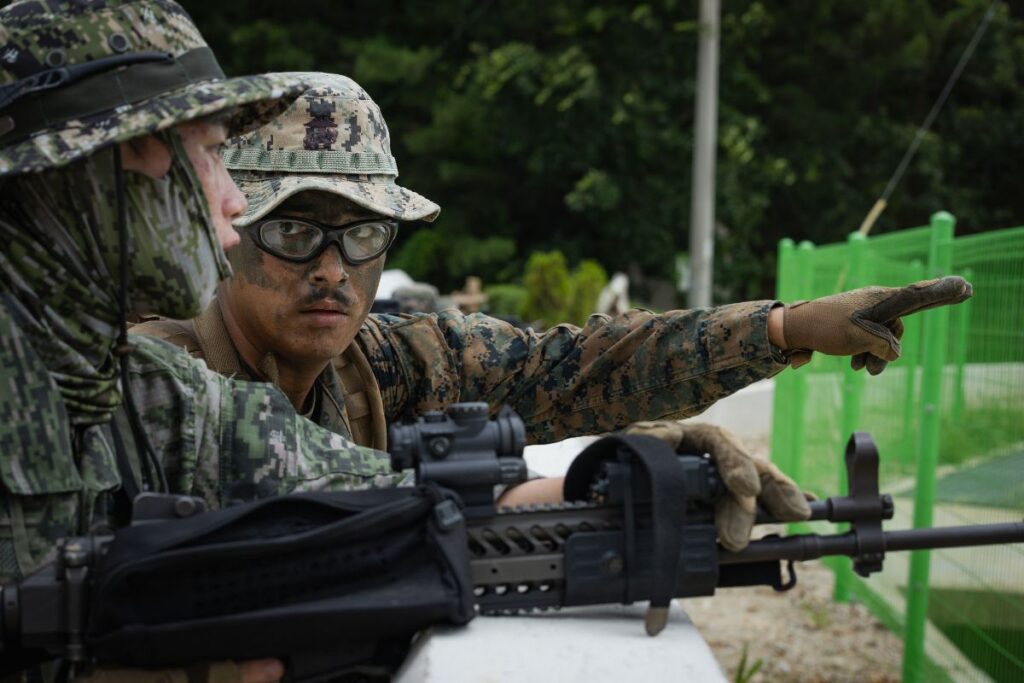
A U.S. Marine with 2nd Battalion, 23rd Marines, forward deployed with 4th Marine Regiment, 3d Marine Division as part of the Unit Deployment Program, identifies targets to a Republic of Korea Marine to coordinate suppressive fires on a simulated enemy positions during the Korean Marine Exercise Program 25.2 in Pohang, South Korea, August 5, 2025. KMEP is conducted regularly between the ROK and U.S. Marine Corps to increase their combined capabilities through realistic training geared towards deterrence and maintaining peace in the Indo-Pacific. (U.S. Marine Corps photo by Lance Cpl. Van Hoang)
Third, we dedicated immense energy, leadership focus, and critical resources to Developing and Retaining High- Quality Marines. Our Campaign Plan identifies our personnel strength as the primary detractor to our readiness. A unit cannot achieve its METs if it lacks the requisite number of Marines with the right skills. An empty seat in a vehicle, a rifle team missing its automatic gunner, or a maintenance bay without a qualified diesel mechanic creates a direct, immediate, and unacceptable degradation of combat power. We are attacking this fundamental challenge on multiple fronts with renewed urgency. We are proud to report that the demand for our service in the Corps remains strong, and as a result of a concerted team effort, the Selected Reserve is exceeding its authorized end strength of 32,500.
But as our plan emphasizes, recruitment is only half the battle. Retention is paramount. Consequently, this year we implemented key initiatives aimed directly at keeping our exceptional Marines in the fold. We established formal mentorship programs across the force, pairing seasoned staff NCOs and officers with our junior Marines to provide them with the guidance they need to navigate the unique challenges of balancing a civilian career with the demands of Reserve duty. We completely revamped our onboarding processes, ensuring that the new Marines’ first few drill weekends are engaging, meaningful, and affirming, rather than a disorienting and demoralizing gauntlet of paperwork and waiting.
We worked tirelessly and collaboratively with our Prior Service Recruiting partners to fill our most critical billets with experienced, proven leaders who bring invaluable fleet experience back into our formations. Furthermore, we understand we cannot expect Marines to remain fully engaged if we do not recognize and leverage the incredible skills they bring from their civilian lives. We are therefore actively working to align their civilian expertise with their military roles, championing talent-matching platforms like GigEagle to ensure we have the right Marine with the right skills in the right billet at the right time, maximizing value for both the Marine and the Marine Corps.
Fourth, we vigorously and enthusiastically executed Enhancing Interoperability and Partnerships. The modern battlefield is, and will continue to be, a team sport. Victory will not go to the force with the most exquisite technology, but to the most cohesive and integrated force. This past year was a landmark for our integration efforts. More than 10,000 of our Marines, which is nearly a third of our entire force, participated in 58 distinct exercises, operating in 25 different countries. They trained shoulder-to-shoulder with their counterparts from the Active Component, the Joint Force, and a broad spectrum of our international allies and partners. This was a deliberate and focused execution of our Campaign Plan’s directive to cultivate deep and lasting relationships at every level. From our Major Subordinate Commands coordinating with theater-level staffs on complex logistical plans down to our individual rifle squads clearing rooms and sharing tactics with servicemembers from allied nations, we ensured our forces are deeply practiced in the complex art of coalition warfare long before the first shots of a crisis are fired. This constant interaction builds trust, shared understanding, and technical connectivity that are the very currency of combined operations. It ensures that when we meet on the battlefield, we are already a team.
Finally, we made significant progress in Embracing Innovation and Modernization. As a fully integrated operational Reserve, we are an active and essential partner in the Marine Corps’ broader, generational Force Design modernization. By reliably assuming critical operational missions with our existing legacy capabilities, we provide the Active Component with the crucial time and strategic space to divest old systems, experiment with new concepts, and field the next generation of warfighting equipment.
Concurrently, we are pursuing our own tailored modernization efforts designed to enhance the lethality of the Total Force. The establishment of our Littoral Craft Companies and the critical upgrades to our F-5 adversary air fleet are tangible, combat-relevant results of this effort. These initiatives provide cost-effective, niche capabilities that directly support the future fight in contested maritime environments. Furthermore, as directed by our Campaign Plan, we moved beyond discussion and are actively exploring how to responsibly harness the power of Artificial Intelligence (AI) and other emerging technologies. We are prototyping AI tools to streamline our staff processes, optimize our limited resources, and accelerate our decision-making cycles, ensuring we can think and act faster than our adversaries.
In closing, the state of our Marine Corps Reserve is strong. It is strong not by chance, but by design. It is strong because it is guided by a comprehensive, detailed, and actionable plan that focuses our efforts and disciplines our initiatives. Our institutional strength is not immutable; it is forged anew each and every day through the quiet, consistent dedication of our Citizen Marines and through the disciplined, collective execution of the Campaign Plan for Comprehensive Readiness. We are a proven operational force, an indispensable partner in modernization, and a prudent, audited steward of the public trust. We are meeting the complex challenges of today while deliberately preparing our formations for the unforgiving conflicts of tomorrow. With your continued support, we will continue to execute this plan with vigor and precision, honor the towering legacy of those who have gone before us, and ensure that the United States Marine Corps Reserve goes into the future as it has always been: Semper Fidelis—Always Faithful.