
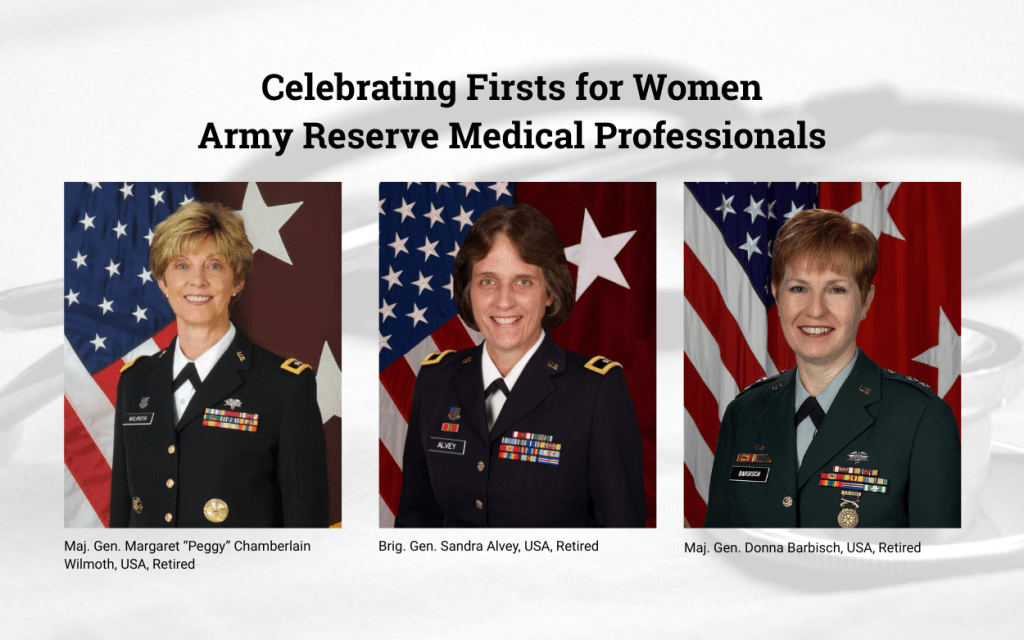
Throughout the history of our military, our amazing women medical professionals in the Reserve Components have accomplished many firsts. So, this month, in honor of Women’s History Month, we are going to highlight several of these trailblazing achievements for our women Army Reserve medical professionals to help celebrate the important and critical roles they have historically played to help keep our troops ready and resilient.
Maj. Gen. Donna Barbisch, USA, Retired
Retired U.S. Army Maj. Gen. Donna Barbisch joined the U.S. Army in 1967. After completing the Army Student Nurse Program, she served in Vietnam as a combat nurse from 1969 to 1970 with the 91st Evacuation Hospital at the Chu Lai Base Area in South Vietnam. Barbisch went on to serve on active duty and in the U.S. Army Reserve for almost 40 years in a variety of roles and leadership positions. Her last assignment before her retirement in 2005 was at the Pentagon, where she oversaw the coordination of the Army’s chemical, biological, radiological, and nuclear defense programs.
Barbisch achieved a number of notable firsts during her nearly four-decade long military career. In 1991, she became the first nurse to command a Mobile Army Surgical Hospital (MASH) when she commanded the 350th MASH in Greenville, North Carolina. She was also the first nurse and woman Vietnam veteran to reach the rank of Major General.
The desire to serve runs strong in Barbisch’s family, as her daughter is currently serving as a Colonel in the Air Force Reserve as the Commander of the 459th Mission Support Group at Andrews Air Force Base.
Maj. Gen. Margaret “Peggy” Chamberlain Wilmoth, USA, Retired
ROA President and retired Army Maj. Gen. Margaret “Peggy” Chamberlain Wilmoth proudly served in the Army Reserve as a Warrior-Citizen for more than 35 years. She was commissioned into the Army Nurse Corps after earning both her Bachelors and Master’s degrees in nursing from the University of Maryland. She later earned her Doctor of Philosophy degree from the University of Pennsylvania.
Over the course of her Army career, Wilmoth commanded units of various size and complexity, including serving as the first nurse commanding general of a medical brigade with responsibility for wartime readiness of all the Army Reserve medical assets in the Southeastern United States, including Puerto Rico. In her final assignment, Wilmoth was promoted to major general and assigned to serve as the Deputy Surgeon General for the Army Reserve. She was also appointed by the Secretary of the Army to serve two terms on the Army Reserve Forces Policy Committee.
Wilmoth was the recipient of numerous military awards and honors throughout her career, including the Distinguished Service Medal, the Defense Superior Service Medal, the Legion of Merit, the Meritorious Service Medal with four Oak Leaf Clusters, and the Expert Field Medical Badge.
In her civilian life, Wilmoth is a Professor at the School of Nursing at the University of North Carolina, Chapel Hill. She is also a Fellow with the American Academy of Nursing, an alumnus of the Robert Wood Johnson Health Policy Fellowship and is co-chair of the North Carolina Institute of Medicine’s Task Force on Veteran Health.
Brig. Gen. Kris Campbell, USA, Retired
Travel opportunities and money to pay for college were two of the amazing military benefits that motivated retired Army Brig. Gen. Kris Campbell to join the Army as part of the Army Student Nurse Program in 1972. She spent more than eight years on active duty before transferring to the Army Reserve. While in the Army Reserve, she held a variety of nursing and training positions and was deployed to Germany during Operations Desert Shield and Desert Storm as well as to Bosnia.
During her deployment to Bosnia in 1997 where she was serving as Chief Nurse, she was selected to command the 396th Combat Support Hospital (CSH), making her the first nurse (active or reserve) to command a CSH in a hazardous duty area.
According to Campbell, she learned many important lessons from her experience in Bosnia, including the importance of preparing, supporting, trusting, and championing your staff; the value in focusing on your work and taking care of your people; and the many opportunities that you get to grow and learn from the people around you.
One of the most important things that she learned from her military experience overall was that her civilian and military leadership roles were complementary. According to Campbell, her “Army leadership development certainly helped me with my civilian roles. As other reservists know, we can live parallel lives (Army and civilian) and each can enrich the other.”
Brig. Gen. Sandra Alvey, USA, Retired
Retired Brig. Gen. Sandra Alvey served for 10 years on active duty and 22 years in the Army Reserve before retiring from the Army in July 2019.
Over the course of her 32-year military career, she held several key leadership roles, including Army Reserve Emergency Preparedness Liaison Officer for the Office of the Secretary of Defense, brigade level Commander of the 196th Medical Support Unit in Germany, and Deputy Commander and Director of Technical Services for the U.S. Army Center for Health Promotion and Preventive Medicine – Pacific in Japan.
In June 2014, Alvey was promoted to brigadier general and assigned to be the Deputy Commanding General for Operations for the 807th Medical Command (Deployment Support), making her the first medical entomologist to be promoted to brigadier general.
Alvey was highly decorated during her military career, receiving numerous awards and honors including the Order of Military Medical Merit, Distinguished Service Medal, Legion of Merit, and Defense Meritorious Service Medal.
In her civilian career, Alvey served as an intelligence analyst with the Defense Intelligence Agency and previously in senior pest management and environmental roles. She has also served in many volunteer leadership roles supporting veterans and military readiness.
Maj. Janet Garvey, USA, Retired
Retired Army Maj. Janet Garvey joined the 343rd Medical Company (Ground Ambulance) in 1981 as a medic and served there as a Reserve Officer Training Corps cadet while attending nursing student at the University of North Carolina, Chapel Hill, and later as a commissioned officer.
Garvey was selected to be the Commander during Operations Desert Shield and Desert Storm and served in both Kuwait and Iraq. At the time she was placed in Command of the 343rd, Garvey was the first Army Nurse Corps officer to command a unit in a theater of war, which, according to Garvey, was one of the greatest privileges of her life. Garvey retired from the Army after 28 years and is currently a nurse practitioner in southwestern Virginia.