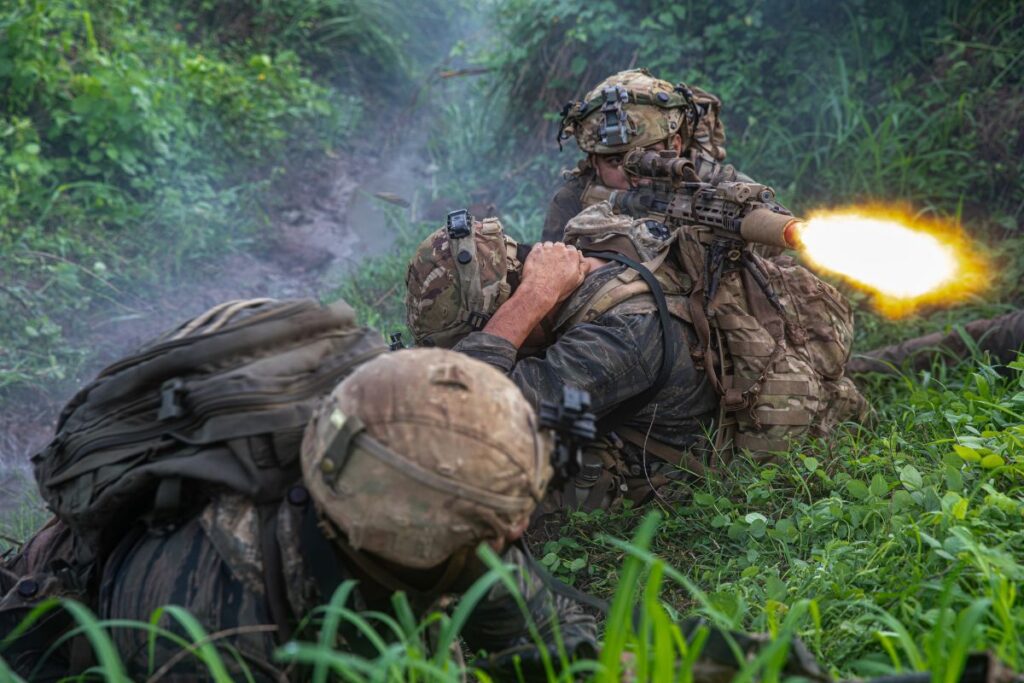
Sgt. Ratu Komaisavai, a sniper assigned to the 100th Infantry Battalion, roleplaying as opposing forces as part of the Joint Pacific Multinational Readiness Center-Exportable exercise at Fort Magsaysay, Philippines. (U.S. Army National Guard photo by Staff Sgt. Thomas Moeger)
By Lt. Gen. Robert D. Harter, Chief of Army Reserve and Commanding General United States Army Reserve Command, Command Sgt. Maj. Gregory Betty, Command Sergeant Major of the Army Reserve, and Command Chief Warrant Officer 5 LaShon P. White, Command Chief Warrant Officer, U.S. Army Reserve Command
The Army Reserve traces its lineage to the first Warrior Citizens of the Revolutionary War, Americans who balanced civilian lives with military service long before the term “Total Force” existed. The model of citizen-based military service—patriots with deep ties across communities—was formalized in 1908 with the creation of the Medical Reserve Corps. That small group of medical professionals addressed a critical wartime shortage by rapidly mobilizing specialized civilian expertise. It worked. Within five years, the Army’s capacity to care for the wounded had quadrupled, and that formula of leveraging specialized civilian sector talent has defined the Army Reserve ever since.
Through two World Wars, Korea, and Vietnam, the Army Reserve has expanded the Army’s depth and resilience, providing combat-ready units and unique capabilities that could not be maintained efficiently in the active force alone. The shift to Total Force Policy in the 1970s— and later refinements—cemented the Army Reserve not as a strategic backup, but as an operational necessity. Over decades of sustained conflict, the Army Reserve transformed to mobilize at scale, integrate seamlessly, and deliver critical capabilities overseas and at home.
That reality defines the present
The unmatched adaptability of the Army Reserve, enhanced by the specialized civilian skills our Soldiers bring to the fight, remains its greatest strength. America’s Army Reserve has evolved into a force with deep regional ties and global reach, providing capabilities not found elsewhere in the Total Army or Joint Force.
Today, approximately 172,000 Warrior Citizens and 10,000 Army Reserve Civilians operate in 25 countries, all 50 states, and five U.S territories. The vast majority of today’s Army Reserve is composed of capabilities essential to major combat operations, such as theater-level transportation and sustainment. The Army Reserve constitutes nearly 20% of the Total Army’s personnel. It provides over half of its Maneuver Support Forces and a quarter of its Mobilization Capacity—all for just 6% of the overall Army budget.
In Large-Scale Combat Operations, the Army’s ability to fight beyond the opening weeks largely depends on military occupational specialties that reside overwhelmingly in the Army Reserve. With over 85% of our force serving part-time, this dependence carries inherent risk.
The Army Reserve is confronting this risk directly through four lines of effort:
- Build Combat Ready Formations
- Mobilize and Deploy
- Adapt, Transform, and Modernize
- Invest in our Soldiers, Civilians, and Families
Our commitment to the Army remains straightforward: “You go, we go.” To deliver on this promise, we are transforming from a force structure built for predictable deployments to a geographic model that better enables readiness and meets the demands of modern warfare.
This shift to Geographic Mission Command shrinks the distances between higher headquarters and their formations, empowering and resourcing leaders at echelon to build readiness. Additionally, this regional focus aligns better with U.S. Army Recruiting Command’s geographic model, bringing Army Reserve leaders and units together with Army recruiting brigades and battalions operating in the same regions.
The Army Reserve is transforming how it trains and fights
The Army Reserve remains focused on building combat-ready Soldiers and formations. More than 200 units and approximately 9,000 Soldiers are mobilized in support of Army and Joint Force requirements. This includes most of the logistics capability support to U.S. Army Central, with more than 4,000 Soldiers managing theater sustainment across the entire U.S. Central Command area of responsibility.
We are building combat lethality through integrated, multi-component exercises. The cornerstone of this effort is Operation Sentinel Justice (OSJ). This large-scale exercise brings together 11,000 Army Reserve and National Guard Soldiers to validate interoperability and test next-generation technologies, such as robotics and counter-drone systems, against a near-peer threat.
OSJ is part of a broader global effort. Currently, more than 3,000 Army Reserve Soldiers are participating in over 80 exercises as part of the Joint Exercise Program, with thousands more preparing to support dozens of additional exercises in the priority U.S. Indo- Pacific Command and U.S. European Command theaters.
At home, the Army Reserve is placing increased emphasis on the Western Hemisphere, with hundreds of Warrior Citizens supporting the Army and the Department of Homeland Security on our Southern Border. Across the U.S., approximately 2,000 troops are scheduled for training exercises. We are also building readiness at home through Innovative Readiness Training, where our Soldiers gain critical skills by leveraging their talents in support of communities across America. Upcoming missions include Tropic Care on Hawaii’s Big Island and Commonwealth of Northern Mariana Islands Wellness, a joint exercise to provide medical services in Saipan, Tinian, and Rota. This not only delivers vital infrastructural support but underscores our commitment to increased engagement throughout the Indo-Pacific region.
Driving readiness through innovation
The Army Reserve is driving transformation by integrating new ideas and technologies directly into our formations. We are streamlining our training enterprise by merging the 108th and 80th Training Commands into a single point of excellence for both Initial Entry Training (IET) and The Army School System (TASS). Meanwhile, the 75th Innovation Command is spearheading our tactical evolution by developing a comprehensive drone strategy and testing over 20 cutting-edge technologies at exercises such as Northern Strike and Sentinel Justice.
We are also transforming how we sustain the fight. Our Multi-Component Support Brigade pilot program aligns an Army Reserve sustainment brigade—the 300th, in Grand Prairie, Texas— directly with an active-duty command—the 13th Expeditionary Sustainment Command, located on Fort Hood. This model is proving the immense value of integrated logistics, enhancing readiness for the entire team. How we have fought throughout history is how we will fight—and win—in the future.
To ensure we can respond at a moment’s notice, we are strategically placing mission-ready equipment sets in Europe and the Pacific. This Forward Positioning of Equipment pilot program enables our Soldiers to deploy faster, train more effectively with our theater allies, and reduce our reliance on stateside equipment, all while building a more agile and responsive force.
The new Army Reserve Center at Camp Williams, Utah, is a prime example of our innovative and fiscally responsible approach to military construction. Through a strategic partnership with the State of Utah, we delivered a new $127M Army Reserve Center, saving over $100M in Military Construction funds and providing modern facilities for 1,800 Soldiers in proximity to National Guard ranges and barracks.
Soldiers and families
When the Nation and its allies face their worst days, our Warrior Citizens are part of the 1% who step forward and say, “I’m ready.” It is an honor for Command Sgt. Maj. Betty, Command Chief Warrant Officer 5 White, and me to lead these awesome patriots.
We are deeply proud of our Soldiers and mindful that our responsibility goes beyond readiness—we must look after their best interests and keep faith with the American public. That trust depends on the support of families, employers, communities, and service organizations who stand behind those who serve.
To uphold that trust, we invest in programs that strengthen readiness and care for our people. Initiatives like the Yellow Ribbon Reintegration Program, Holistic Health and Fitness (H2F), and the Private Public Partnership (P3) program ensure our Soldiers, civilians, and families are supported across all domains—physical, mental, and professional.
Through H2F, we improve readiness and quality of life by focusing on total wellness. Through P3, we connect Soldiers and families to meaningful employment opportunities, reinforcing long-term stability and success.
We remain committed to leading by example, caring for our people, and honoring the trust placed in us by the American people.
Looking ahead, transformation accelerates
From the first Warrior Citizens to the complex battlefields of tomorrow, the Army Reserve has always adapted to meet the Nation’s call. Today is no different. In an era of accelerated transformation, we are forging a more lethal and agile force through innovation and strategic integration to deliver combat-ready Soldiers and formations at time of need.
Through our geographic command structure, we are placing leadership where it matters most—across the communities we recruit from and alongside our active-duty and National Guard partners. Through innovation, we are putting next-generation technologies such as advanced drones and robotics into the hands of our Soldiers. And through integrated programs, such as our Multi- Component Support Brigade and forward-positioned equipment, we are ensuring we can deploy faster and sustain the fight longer.
This is not a distant concept; it is happening now, ensuring the critical enabling capabilities the Army and Joint Force depend on are ready at the moment of need. The Army Reserve is transforming to deliver on its purpose. We will be ready.
Twice the Citizen, Combat Ready—This We’ll Defend.
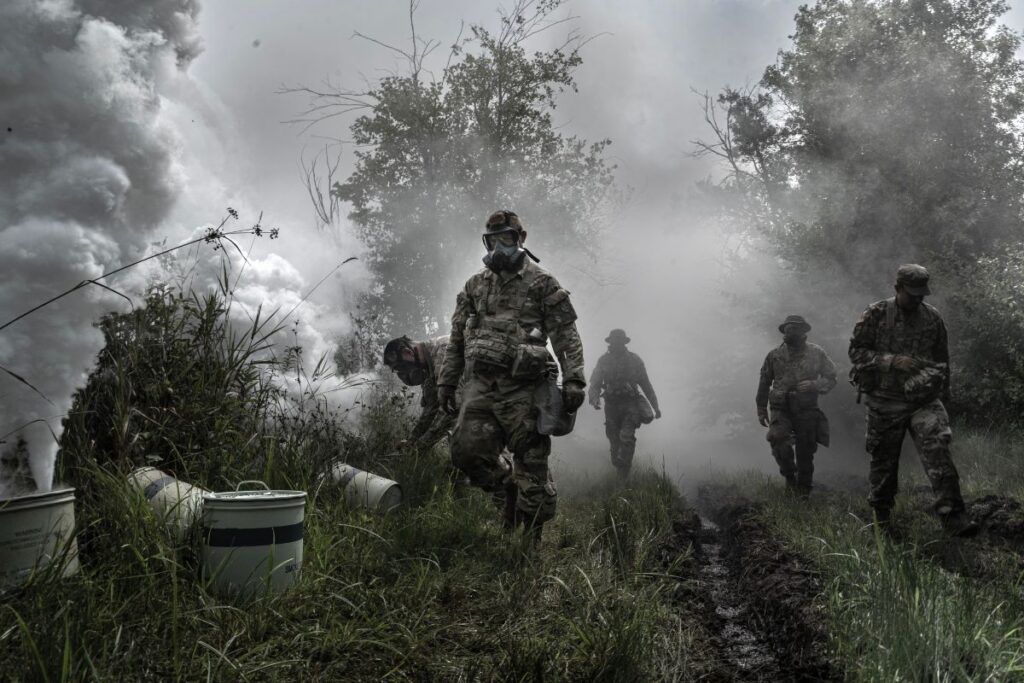
Soldiers from the 351st Ordnance Company provide smoke coverage as engineers construct a multi-role bridge
to cross a wet gap at Global Strike 2025 during the Combat Support Training Exercise at Fort McCoy, Wisconsin. (Photo by Staff Sgt. Philip Ribas)