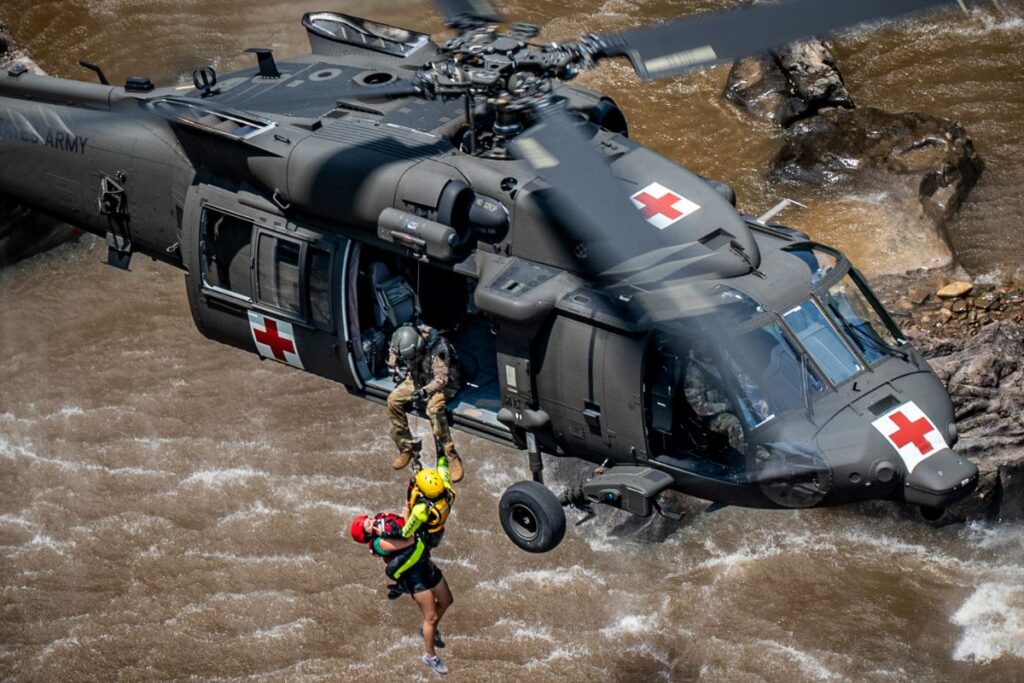
Members of the West Virginia National Guard’s Company C., 2-104th General Support Aviation Battalion conduct swift water rescue operations training and certification during their annual training period at Camp Dawson, Kingwood, West Virginia, July 17, 2025. Pilots and aircrew practice precision flying in tight airspaces, retrieving personnel via lift hoist baskets, and rescue crewman assists. These capabilities can be incredibly important to save the lives of U.S. citizens during flash floods and other flooding events. (U.S. Army National Guard photo by Edwin L. Wriston)
By John T. Raines III, Senior Enlisted Advisor to the Chief, National Guard Bureau
The strength of the National Guard has never lived in titles or headquarters buildings. It lives in the men and women who lace up their boots before dawn, leave their civilian jobs and families behind, and turn national strategy into decisive action.
After reading Chief of the National Guard Bureau, General Steven Nordhaus’ reflection on where the Guard has been and where it is going, I felt immense pride—not just in our history, but in the force that continues to write that history every day. As the Senior Enlisted Advisor of the National Guard, I want to offer a perspective from the ground level: the grit, ingenuity, and quiet professionalism of the enlisted force who transform broad strategy into real-world results.
Then: Ordinary Americans, extraordinary resolve
Our story begins in 1636, when colonial militias formed to defend their communities. They were farmers, tradesmen, and neighbors— citizens first—who stood ready when danger threatened their homes.
That tradition was tested at Lexington Green in April 1775, when citizen-soldiers defied the world’s most powerful military force. They were not professional warriors. They were Americans defending their homes, their families, and the radical idea of liberty.
Five years later, at the Battle of Kings Mountain, frontier riflemen climbed steep terrain under heavy fire and overwhelmed Loyalist forces in one of the Revolutionary War’s most decisive victories.
Their success came from grit, marksmanship, and a shared belief that the cause of freedom was worth defending.
The victory at Kings Mountain helped shift momentum in the Southern Campaign and paved the way for eventual success at Yorktown. It also reinforced a truth that would echo through American history: when ordinary Americans are called to serve, they rise to extraordinary challenges.
That legacy lives on today. Of the Army’s 34 units with lineage tracing back to the Revolutionary War, 33 are in the National Guard. That lineage is not ceremonial—it is cultural. It reflects a tradition of resilience, adaptability, and determination passed from one generation of Guardsmen to the next.
As Teddy Roosevelt famously said, “The credit belongs to the man who is actually in the arena,” and that’s us, the Guardsmen who have always been there, muddy, determined, and building America’s strength from the ground up. From the earliest militias to the modern National Guard, citizen-soldiers have stood at the intersection of community and national defense. They have served governors at home and the nation abroad, proving time and again that military excellence does not require separation from civilian life. In fact, it is strengthened by it.
Now: Ready at home and abroad
In June 2025, Operation Midnight Hammer showcased the Guard’s global reach. Airmen from Missouri’s 131st Bomb Wing helped prepare B-2 bombers for one of the longest operational missions in the aircraft’s history. Many of the maintainers responsible for those aircraft also work civilian jobs as engineers, mechanics, and technicians. Their expertise—and their ability to innovate under pressure—ensured that those bombers remained mission-ready.
Then came Operation Absolute Resolve in Caracas, where more than 150 aircraft converged for a high-risk extraction. Guard members from across 54 states and territories handled refueling, communications, and tactical support, ensuring no component failed. Their seamless integration with active-duty forces proved that the total force concept works because of our people. Across the globe and across the homeland, Guardsmen continue to prove the value of the Total Force.
When hurricanes, floods, and wildfires strike, the National Guard is often the first military force on the scene. In late 2024, more than 21,000 Guardsmen from 43 states mobilized to respond to Hurricane Milton. I was serving as the Army’s National Guard Command Sergeant Major for that response. I witnessed Soldiers and airmen wading through floodwaters to rescue families, clear debris, and distribute emergency supplies. Over the course of the response, they delivered more than 2.4 million hours of direct support to affected communities.
1st Sgt. Pedro Montero of the Florida National Guard said, “These aren’t just strangers; they’re our neighbors.”
Our partnerships with local agencies are ever-present. In California, thousands partnered with first responders during devastating wildfires. Along the southern border, 1,500 Guardsmen augmented law enforcement, with Texas Guard drone operators providing aerial overwatch. Nationwide, we logged 1 million manning days supporting state and federal police agencies, with 3,800 members in 19 states, handling administrative and logistical tasks.
The Guard’s impact is just as significant in emerging domains. More than 400 Guard cyberprofessionals were activated in 2025 to counter network intrusions and defend critical systems. Their effectiveness comes from a unique advantage: many of them work in cybersecurity or information technology in their civilian careers. They bring that civilian expertise directly into uniform. In Massachusetts, Senior Master Sgt. Taylor Gow invented the Agile Cyber Training Environment (ACTE). This portable, backpack-sized platform allows cyber teams to train anywhere, without costly infrastructure. That kind of innovation is not the exception in the Guard. It’s what happens every single day.
Training and readiness tell the same story. Recruiting exceeded end-strength goals, hitting 103% in 2025. We aced two Combat Training Center rotations, exportable exercises with 7,000 Soldiers, and Division Warfighters. Pennsylvania Guard snipers topped the Winston P. Wilson; mortar crews placed second; cyber teams won SANS for the fifth time in six years; and a Pennsylvania team innovated to win the Army’s first Best Drone Warfighter Competition.
Recently, I visited Puerto Rico’s Best Warrior competition, where competitors showed grit and grueling endurance in events that balanced federal missions with leader development training. Competitions like this take place all over the country every year. In Minnesota, at -30 degrees, I met with senior enlisted leaders at Camp Ripley, who focused on readiness and leadership. In Colorado, Guardsmen executed homeland defense around the clock. These examples are just a few of the extraordinary ways in which our force is establishing deterrence, strengthening readiness, and expanding warfighting capabilities while defending the homeland.
Today, the National Guard represents roughly 20% of the Joint Force while receiving only about 4% of the defense budget. Yet the force consistently delivers capabilities that far exceed that proportion.
The reason is simple: the Guard is powered by people whose civilian expertise strengthens military readiness. In a single unit, you might find engineers, teachers, business owners, elected officials, logistics professionals, first responders, and cybersecurity specialists. Together, they bring an unmatched breadth of experience to every mission. As Colin Powell once said, “Leadership is all about people. It is not about organizations. It is not about plans. It is not about strategies. It is all about people—motivating people to get the job done. You have to be people-centered.”
That idea—simple but profound—captures the enduring strength of the National Guard. Our history, our present, and our future are defined not by institutions but by citizens who choose to serve.
Tomorrow: Innovation and readiness
As the strategic environment evolves, the National Guard is preparing for the challenges ahead. The 2026 National Defense Strategy emphasizes speed, integration, and an AI-enabled force. Guardsmen are already helping lead that transformation.
Programs like ARCWERX connect Airmen with industry partners to rapidly prototype solutions to operational challenges. Meanwhile, the National Guard State Partnership Program continues expanding global relationships between Guardsmen and partner nations. The State Partnership Program (SPP) expanded to 116 nations—60% of the world—through 1,770 events in 2025.
Guardsmen built trust through exercises such as Justified Accord 2026 in Kenya and Brave Band in Poland, sharing skills with partners, including Qatar’s forces, to support Scouting America security. The State Partnership program will continue expanding, deepening alliances that complicate adversary decision-making and strengthen collective defense. Trust built over decades becomes a strategic advantage in a moment of crisis.
At home, Guard units are modernizing alongside the active components, integrating advanced aviation platforms, cyber capabilities, and data-driven systems that will shape the future battlefield. Like Oregon’s Staff Sgt. Kenneth Fritz, who invented jet maintenance tools, or Connecticut’s repair depot, sustained aviation readiness. We are 42% of the Army’s operational forces and 30% of the Air Force, providing cost-effective depth and innovation to warfighters across our formations.
As the United States approaches its 250th anniversary, the National Guard stands ready to continue that tradition. We will remain ready at home, prepared to defend communities in times of disaster and crisis. We will stand ready abroad, deterring aggression and strengthening alliances. We will continue to innovate—drawing on the talent, creativity, and commitment of the Citizen Soldiers and Airmen who make this force unique. We will anticipate change, we will prepare relentlessly, and when called, we will be there.
From the farmers who stood on Lexington Green to the men and women of today mastering their military specialties, the story of the National Guard has always been a story about people. People who step forward when their nation calls. People who serve their communities with pride. People who carry forward a legacy nearly four centuries in the making.
To the Guardsmen serving today, to the families who support them, and to those who served before them: you are the heart of the National Guard. Then and now, we are Stronger Together, Stronger Tomorrow.